

Introduction
The foundation of any thriving business be it a startup, agency or a global brand is its marketing fundamentals. Knowing the basics of marketing can guide you to find the right audience, convey your worth, and spur uninterrupted growth.
In the competitive world today, merely having an understanding of what is marketing is not sufficient. You must know the fundamentals of marketing, the fundamentals of marketing, and the contemporary marketing approaches that are in line with digital attitude and the changing customer expectations.
The guide will take you through it all, including marketing principles and marketing mix (4Ps) as well as practical examples and strategies.
What Are Marketing Fundamentals?
Marketing fundamentals can be distinguished as the main principles, strategies, and concepts that companies rely on to advertise products or services and reach their target audience.
In essence, marketing is concerned with:
- Understanding customer needs
- Developing a good value proposition.
- Creating value by using the appropriate marketing channels.
Simple Definition:
The principles of marketing consist of the simplest building blocks that assist businesses in attracting, engaging, and converting customers.
Example:
One of the local clothing brands defines the buyer persona, designs trendy clothes, markets them on Instagram, and makes sales using WhatsApp- this is the basics of marketing in action.
The importance of Marketing Fundamentals
Marketing basics are vital in establishing a solid foundation in any business. Even the finest products may not find it easy to be noticed and make a mark without understanding the fundamentals of marketing. The most important basics of marketing, including finding your target audience, establishing a clear value proposition, and selecting the appropriate marketing channels, are vital to success in the long term and sustainable growth.
Key Benefits:
1. Better Customer Understanding
Helps identify your target audience and create the right buyer personas.
2. Improved Customer Acquisition
Good fundamentals lower the customer acquisition cost (CAC) and enhance conversions.
3. Strong Brand Positioning
Brand positioning makes you stand out among competitors.
4. Increased ROI on Marketing.
Strategies based on data enhance ROI in marketing.
Essential Marketing Fundamentals Basics You should be aware of.
In order to have a good foundation, you should be able to grasp some of the basics of marketing and the main marketing concepts described in simple language. These are knowing who your target market is, making a compelling value proposition, the marketing mix (4Ps), and the appropriate marketing strategies. The knowledge of these marketing basics can enhance customer interaction, positioning of a brand, and general business development.
1. Target Audience & Buyer Persona
The audience that you are targeting is the one that is most likely to purchase your product.
A buyer persona is a comprehensive description such as:
- Age, gender
- Interests
- Pain points
- Buying behavior
Example: A digital marketing agency that focuses on startup founders between 25-40 years old.
2. Value Proposition
The value proposition to your product is:
Why would the customers select you?
It should be:
- Clear
- Unique
- Benefit-driven
Examples: 3X more leads using AI-powered SEO strategies.
3. Marketing Mix (4Ps / 7Ps)
The marketing mix is one of the most important fundamentals of marketing.
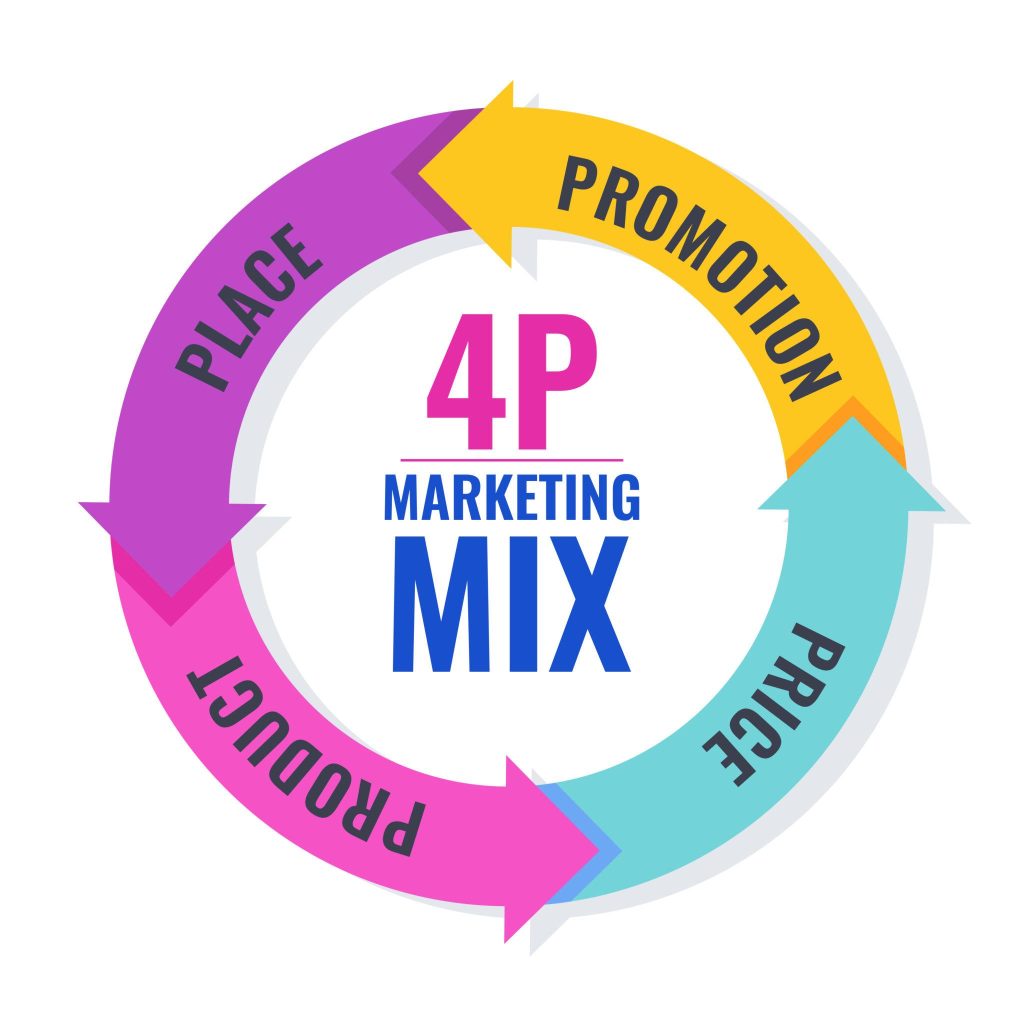
Marketing 4Ps:
- Product
- Price
- Place
- Promotion
Now Marketing 4Ps Extended to 7Ps with:
- People
- Process
- Physical Evidence
This model will have your marketing strategy fundamentals in place.
4. Customer Journey
The customer journey illustrates the interaction of the customer with your brand along different touchpoints, starting with the initial encounter to the ultimate purchase and more. The insights on this journey are fundamental to marketing basics, as they assist companies to coordinate their marketing strategies, enhance the customer experience, and raise the overall rate of conversion and retention.
1. Awareness
It is the initial step, and potential customers learn about your brand via different marketing channels including SEO, social media marketing, paid advertisements, or content marketing. At this stage, users are not prepared to purchase, they are merely getting familiar with a problem and doing research on how to resolve it.
Objective: Raise awareness and find the right target audience through informative and engaging content.
2. Consideration
At this step, users begin to compare and contrast various alternatives and determine which solution fits their needs best. They interact more with your content- reading blogs, watching videos, checking reviews or downloading guides.
Objective: To build trust, emphasize your value proposition and make your brand the best option by building a strong brand positioning and useful content.
3. Decision
The user is now prepared to do something at the decision stage, be it purchase or sign-up or call your business. Such aspects as price, reviews, promotions, and convenience of shopping are important in this case.
Objective: Minimize the conversion rate by offering transparent CTAs, social proof, and a user-friendly user experience.
Pro Tip: Organizations that are good at streamlining every step of the marketing funnel can really enhance customer acquisition and create a retention strategy that will support growth in the long term.
This knowledge assists in enhancing conversion rate.
5. Marketing Channels
Marketing channels refer to the avenues and modes through which businesses reach out to their target market and market their products or services. The selection of the appropriate combination of channels is an important aspect of marketing basics since this directly influences customer acquisition, engagement, and overall ROI in marketing.
Key Marketing Channels:
A. SEO (Search Engine Optimization)
One of the best inbound marketing strategies that can enable your site to be ranked higher in search engines such as Google is SEO. The ability to attract organic traffic and create long-term outcomes through the targeting of relevant keywords and optimization of content allows businesses to focus on attracting organic traffic.
Ideal use: Sustainable growth, high intent users and enhancing conversion rate over time.
B. Social Media Marketing
Instagram, Facebook, and LinkedIn are social media platforms that enable brands to interact with their audiences. It assists in creating brand awareness, brand positioning, and building a loyal community.
Suits best: Engagement, visibility, and interaction with the audience.
C. Email Marketing
Email marketing is an effective strategy in cultivating leads and sustaining relationships with current customers. It facilitates retention strategy by providing personalized content, offers and updates in the inbox of the users.
Use: Lead nurturing, repeat sales and customer retention.
D. Paid Advertising (PPC)
Paid advertisements (Google Ads and social media ads) aid companies in getting to a specific audience in a short period of time. This outbound marketing approach provides direct exposure and quantifiable outcomes upon proper optimization.
Ideal use: Rapid customer acquisition, scaling, and experimentation with marketing strategies.
Pro Tip: An effective digital marketing plan will frequently integrate various marketing channels to form an omnichannel marketing campaign, which will guarantee uniformity in communication and improved outcomes throughout the whole customer experience.
The decision to use the appropriate channels is essential in acquiring customers.
6. Branding & Positioning
Your brand is how people perceive you.
Good brand positioning generates:
- Trust
- Recognition
- Loyalty
Examples: Apple = Premium + Innovation.
Marketing Fundamentals Funnel Explained
Marketing funnel is one of the fundamental marketing strategy concepts.
Funnel Stages:
1. Awareness
Individuals learn about your brand.
Example:
A user searches “marketing basics” on Google and finds your blog through SEO or sees your Instagram post explaining marketing fundamentals.
2. Consideration
They compare options.
Example:
The same user reads multiple blogs, checks your services page, compares your agency with competitors, and downloads a guide on digital marketing strategy.
3. Conversion
They make a purchase.
Example:
The user fills out your “Get Free Strategy Call” form or purchases your SEO service after seeing testimonials and case studies.
4. Retention
Regulars- repeat customers- retention strategy.
Example:
You send regular performance reports, email tips, and exclusive offers, encouraging the client to continue using your services or upgrade packages.
Marketing types (Digital + Traditional)
It is critical to know the kinds of marketing strategies.
Digital Marketing
Includes:
- SEO
- PPC
- Content marketing
- Social media marketing
- Content Marketing
Production of blogs, videos, guides to appeal to users.
Important in the inbound marketing
Social Media Marketing:
Social media marketing is a critical component of inbound marketing, which assists companies to engage directly with their target market on websites such as Instagram, LinkedIn, and Facebook. It is important in creating brand awareness, enhancing customer interaction, and brand positioning. Consistent content and interaction can significantly boost visibility and trust.
Such platforms as Instagram, LinkedIn, Facebook.
Email Marketing:
The email marketing is among the best marketing tools to nurture the leads and enhance customer relationships. It assists businesses in creating leads, providing personalized content and retention strategy. Through targeted campaigning, brands are able to boost conversion rate, repeat purchases and ROI in marketing.
Best to develop leads and enhance retention.
Traditional Marketing:
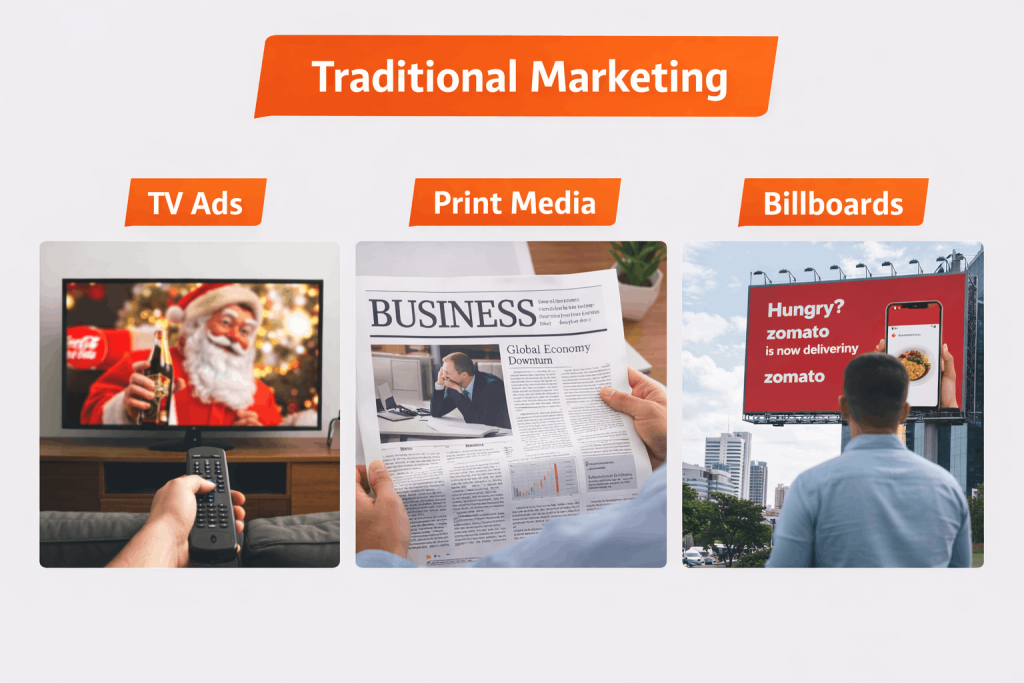
Traditional marketing can be considered as offline promotional tactics that are employed to target a wide target market using mass communication. Although digital platforms are on the rise, it is a significant aspect of marketing basics, particularly in developing a good brand awareness and local presence.
TV Ads Marketing
Television advertising enables brands to reach out to millions of people simultaneously, thus it is effective when it comes to large scale campaigns and emotional storytelling.
Example:
A brand such as Coca-Cola will advertise on TV around a big event to reinforce brand positioning and emotionally connect with viewers.
Print Media Marketing
Print media consists of newspapers, magazines, brochures, and flyers. It can be helpful to address particular areas or groups and gain trust.
Example:
A real estate firm will advertise in the newspapers to ensure that local clients interested in making investments in property are attracted.
Billboards Marketing
Billboards are outdoor posters that are placed in busy environments to be noticed and remind consumers of the brand.
Example:
A food delivery company such as Zomato uses innovative billboards in major cities with metro to make the company more visible and appealing to the local customers.
Pro Tip: A blend of both traditional and online marketing forms an effective omnichannel marketing strategy, which enhances reach, interaction, and customer acquisition.
Nonetheless, traditional marketing is still important for building strong brand awareness.
How to Build a Marketing Strategy (Step-by-Step)
The development of an efficient marketing plan is crucial in prioritizing and realizing a steady business growth. It makes you concentrate on the appropriate marketing channels, know your target audience and work towards what you want to achieve. Through a step-by-step process, including researching your audience, setting goals, choosing the most appropriate platforms and monitoring performance, you will be able to develop a data-driven digital marketing plan that will help you better attract customers, increase your conversion rate, and achieve the best ROI in marketing.
This part is vital in prioritization. Let’s go deeper in it.
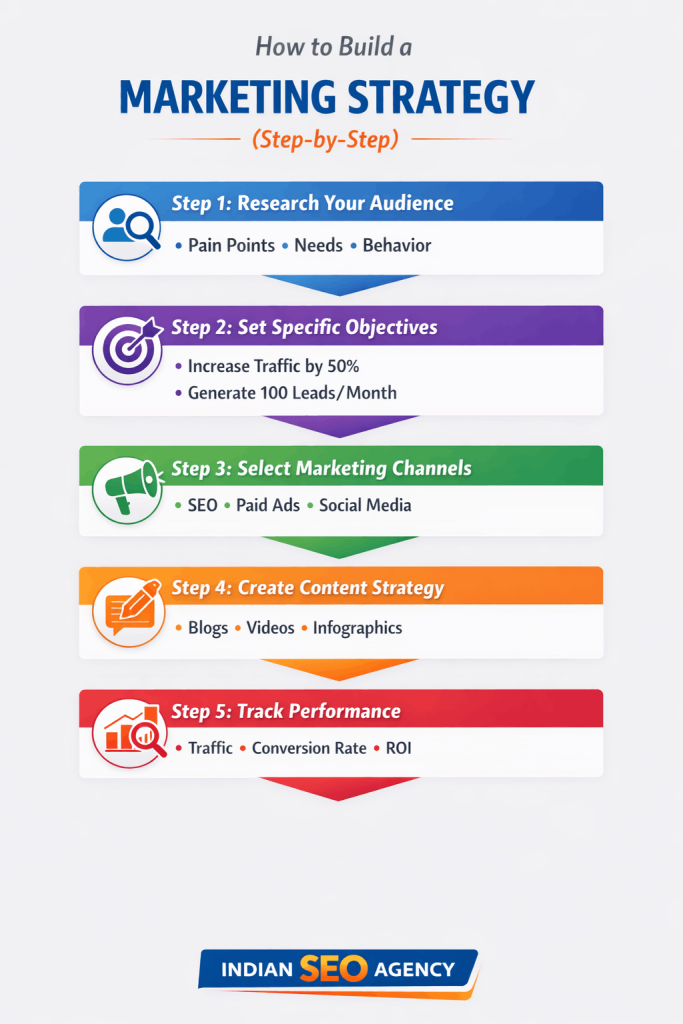
Step 1: Research Your Audience.
Understand:
- Pain points
- Needs
- Behavior
Step 2: Set Specific Objectives.
Examples:
- Increase traffic by 50%
- Generate 100 leads/month
Step 3: Select Marketing Channels.
Focus on:
- SEO
- Paid ads
- Social media
Step 4: Create Content Strategy
Use:
- Blogs
- Videos
- Infographics
Step 5: Track Performance
Measure using tools:
- Traffic
- Conversion rate
- ROI
Case Studies: Real Examples of Marketing Fundamentals in Action
Apple
- Strong brand positioning
- Premium pricing strategy
Strategy: Strong Brand Positioning + Premium Pricing
Action:
- Apple did not compete based on price but positioned itself as a premium and innovative brand.
- Dedicated to the minimalist design, ecosystem (iOS), and user experience.
- Introduced iconic campaigns such as the Think Different.
- Premium pricing strategy (no intense discounts)
Result:
- Apple has emerged as one of the most valuable brands in the world.
- Has a high profit margin (~40% on iPhones)
- Good customer loyalty and repeat buying.
Source:
Nike
- Emotional branding
- Powerful storytelling

Strategy: Emotional Branding + Storytelling
Action:
- Launched powerful campaigns like “Just Do It”
- Used real athlete stories (e.g., Colin Kaepernick campaign)
- Focused on emotion, motivation, and identity, not just products
Result:
- After the Kaepernick campaign:
- Sales increased by 31% (in days)
- Became a leader in sports branding globally
Source:
- https://www.edelman.com/research/nike-kaepernick-campaign
- https://www.statista.com/topics/1243/nike/
Zomato
- Social media engagement
- Local targeting

Strategy: Social Media Engagement + Local Targeting
Action:
- Created funny, relatable content on Twitter & Instagram
- Used hyper-local marketing (city-based offers & messaging)
- Sent personalized push notifications
- Leveraged memes + trending topics
Result:
- Massive social media following & engagement
- High app usage and customer retention
- Strong brand recall in India
Source:
- https://yourstory.com/2020/02/zomato-marketing-strategy
- https://www.businessinsider.in/advertising/brands/article/how-zomato-wins-social-media/articleshow/73401868.cms
The core marketing concepts are applied in these brands.
Common Marketing Mistakes to Avoid
Many beginners make common mistakes while learning marketing fundamentals, which can slow down growth and reduce results. One of the biggest errors is not clearly defining the target audience, leading to poor engagement and wasted efforts. Ignoring data and analytics, having a weak value proposition, and using the wrong marketing channels can also hurt performance. To succeed, businesses must follow proven marketing strategies, stay consistent, and continuously optimize for better conversion rate and ROI.
- Lack of a definite target audience.
- Weak value proposition
- Ignoring data & analytics
- Inconsistent branding
- Failing to maximize conversion rate.
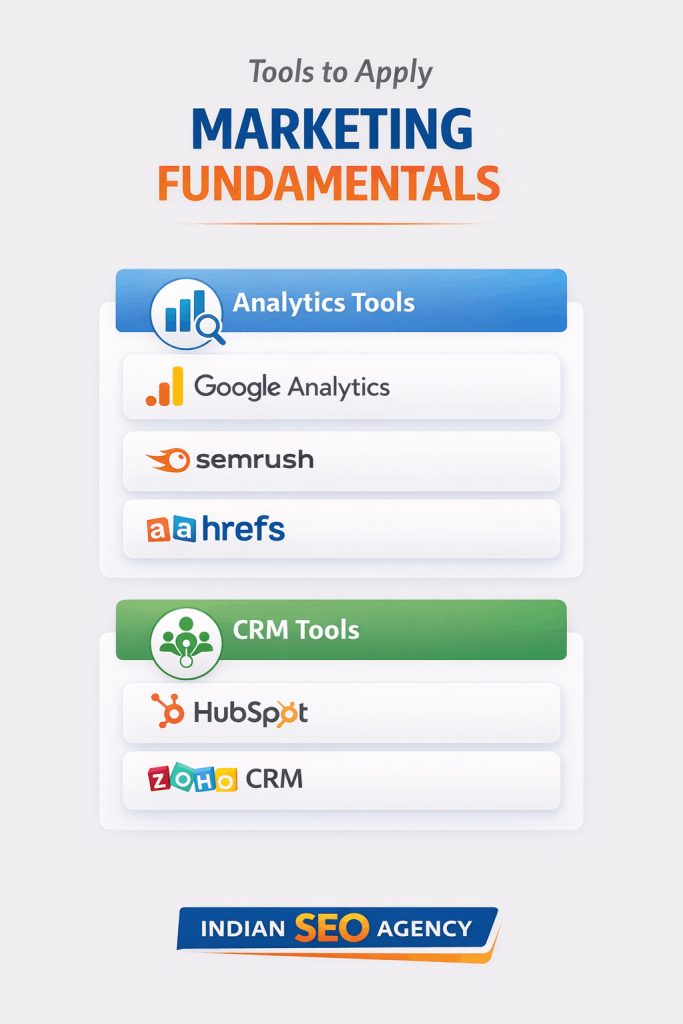
Tools to Apply Marketing Fundamentals
Analytics Tools
- Google Analytics
- SEO Tools
- Semrush
- Ahrefs
Also Read : Best Free SEO Tools List (2026) – Tools for Every SEO Task
CRM Tools
- HubSpot
- Zoho CRM
FAQs (SEO + Featured Snippet Optimized)
1. What are the 7 building blocks of marketing?
The 7 fundamentals are Product, Price, Place, Promotion, People, Process, and Physical Evidence.
2. Marketing basics: What is marketing to a beginner?
The essentials of marketing are to know your targeted audience, develop a value proposition, select channels, and monitor performance.
3. What is the marketing mix?
The marketing mix is the 4Ps of Product, Price, Place and Promotion that are employed to market a product.
4. Where do I begin to learn marketing?
Begin with the basics of marketing, acquire the basics of digital marketing, and test it out with real campaigns.
Conclusion
To create a successful business in 2026 and further, mastering marketing basics is key. No matter which stage of marketing you are studying, these tenets will help you develop.
Knowing your target audience, marketing funnel, branding and channels will enable you to develop a potent strategy that will lead to actual results.
Begin implementing these marketing fundamentals today and develop a scalable, data-driven marketing system.
Looking to implement these strategies? Work with a trusted digital marketing agency in India to scale faster.