

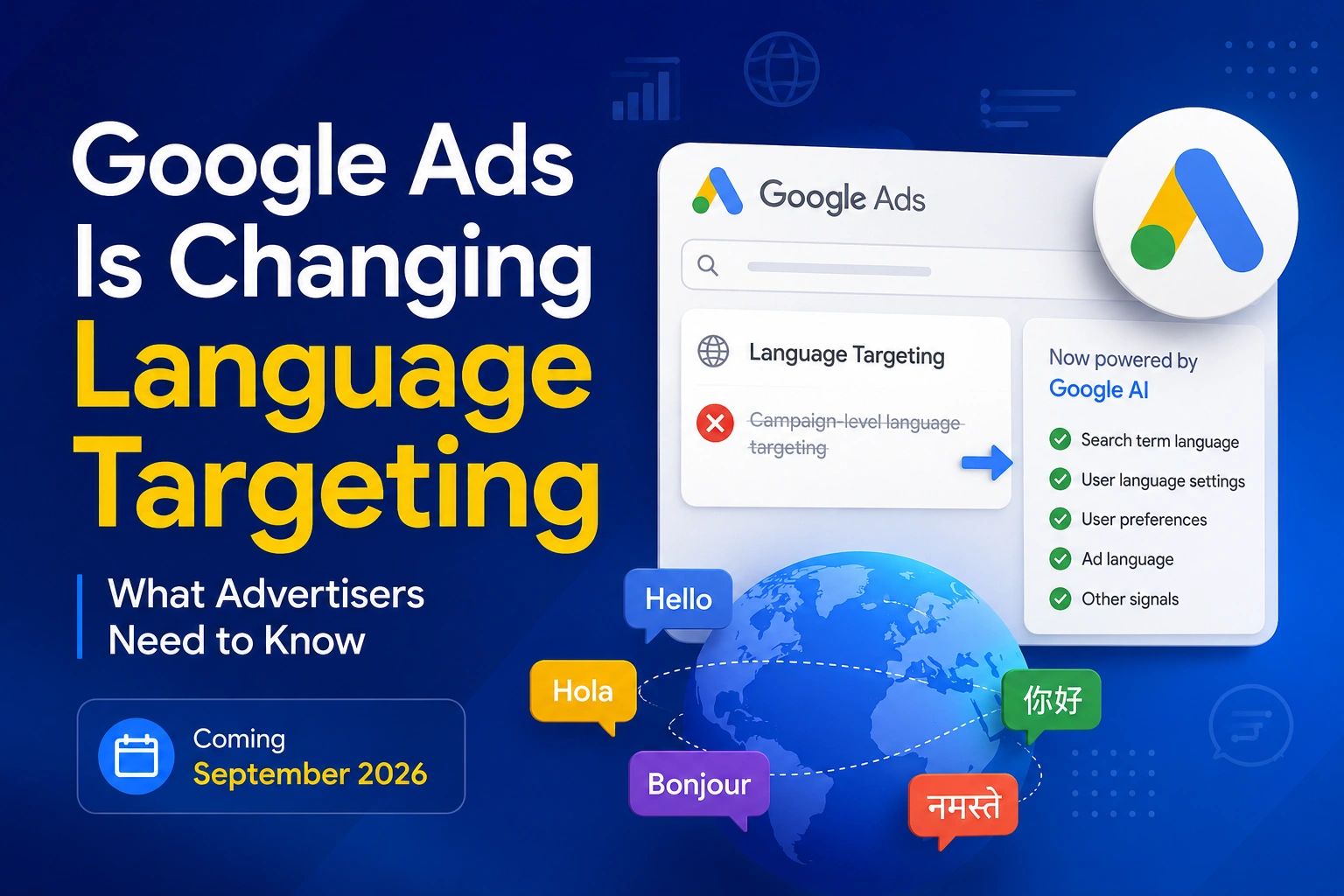
Google Ads is changing how language targeting works for Search campaigns starting in September 2026. One of the most important changes is the removal of the campaign-level language targeting setting for Search campaigns.
Instead of advertisers manually selecting the languages they want to target at the campaign level, Google will increasingly use automated signals to determine which language is most appropriate for an individual search and user.
This change is part of Google’s broader shift toward AI-driven campaign optimization, where search intent, user behavior, ad relevance, landing-page content, and other contextual signals play a greater role in determining ad delivery.
For advertisers managing multilingual campaigns, international PPC campaigns, or campaigns targeting customers who search in more than one language, understanding this change is important.
Summarize This Article With AI
Article Summary
Starting in September 2026, Google Ads will change how language targeting works for Search campaigns.
The key change is:
Campaign-level language targeting will be removed from Search campaigns.
Google will instead use signals such as:
- The language of the user’s search
- The languages the user is likely to understand
- User language settings and preferences
- The language of available ads
- Other contextual and AI-driven signals
For Performance Max campaigns, the language setting will no longer apply to ads shown on the Google Search Network. However, language settings will continue to apply to other channels such as YouTube, Display, Discover, and Gmail.
The practical implication is that advertisers will need to pay more attention to ad copy, landing-page language, keyword intent, campaign structure, conversion tracking, and overall messaging consistency.
What Is Google Ads Language Targeting?
Google Ads language targeting is a feature that has traditionally allowed advertisers to specify the languages of customers they want their campaigns to reach.
For example, an advertiser could create a Search campaign and select English, Spanish, French, or another supported language as a targeting criterion.
Language targeting was designed to help advertisers show ads to people who are likely to understand the language used in the advertisement.
However, user behavior has become much more complex.
A person may have their browser or device configured in one language, search in another language, and still understand advertisements written in a third language.
Google’s updated approach is designed to account for this complexity.
According to Google, Search campaigns will use signals including the search term language, user language settings, preferences, and other indicators of which languages a user understands.
What Is Changing in Google Ads Language Targeting?
The major change begins in September 2026.
For standard Google Search campaigns, the campaign-level language targeting setting will be removed.
This means advertisers will no longer control Search ad delivery by simply selecting a list of campaign-level languages in the same way they have historically done.
Instead, Google will automatically evaluate the available signals and determine which ads are appropriate for the user.
Previously
Advertisers could use campaign-level language settings to indicate which languages they wanted to target.
Going forward
Google will automatically match ads based on signals about:
- The user’s search
- The language of the ad
- The user’s language preferences
- The languages Google believes the user understands
- Overall search context and relevance
This represents a broader move from manual targeting controls toward automated, context-based ad matching.
How Will Google Determine Which Language Ad to Show?
Google’s updated language matching system is not based on a single signal.
Instead, Google can consider multiple indicators when deciding which ad language is appropriate.
1. Search Term Language
The language used in the search query can provide an important indication of what the user is looking for and which language may be appropriate for the advertisement.
However, search language is not necessarily the only factor.
A multilingual user may search for a product in one language while understanding advertisements in another.
2. User Language Settings
Google can consider language settings associated with the user’s Google account, browser, device, or other available signals.
These settings can help Google understand the languages a user may understand.
3. User Preferences and Behavior
Google can use broader signals to determine whether a user understands a particular language.
For example, someone may regularly search in English even if their device interface is configured in another language.
4. Ad Language
The language used in your headlines, descriptions, and other advertising assets becomes increasingly important because Google needs to determine whether the ad is relevant and understandable to the user.
5. Overall Search Context
Google’s AI-driven systems can evaluate the broader context of the search rather than relying exclusively on traditional targeting settings.
This means language relevance and ad quality become increasingly connected.
Why Is Google Removing Campaign-Level Language Targeting?
The change reflects a larger evolution in Google Search advertising.
Modern search behavior is increasingly multilingual and contextual.
Consider a user who:
- Has a Hindi-language phone
- Uses an English browser
- Searches for products in English
- Watches content in Hindi
- Reads websites in both English and Hindi
A traditional campaign-level language setting may not fully represent that user’s actual language understanding.
Google’s automated approach is intended to provide more flexibility by evaluating multiple signals instead of treating language as a simple campaign-level checkbox.
This is consistent with Google’s broader move toward AI-powered Search advertising and automated optimization.
What Does This Mean for Advertisers?
The most important takeaway is that language targeting is becoming less about a campaign setting and more about the quality and context of the advertising ecosystem around the campaign.
Advertisers should therefore review several areas.
1. Review Your Ad Copy
Your headlines and descriptions should clearly communicate the value proposition in the language you want customers to understand.
If you operate multilingual campaigns, avoid mixing languages unnecessarily within the same ad experience unless there is a clear strategic reason.
Your ad messaging should be:
- Clear
- Natural
- Relevant to the search intent
- Consistent with the landing page
- Appropriate for the target audience
2. Review Your Landing Pages
Landing-page language becomes especially important in an environment where Google is using contextual signals to match ads with users.
If your advertisement is written in Spanish but the landing page is entirely in English, the overall user experience may be less consistent.
For multilingual advertising, consider creating dedicated landing pages for major languages.
For example:
English Search → English Ad → English Landing Page
Spanish Search → Spanish Ad → Spanish Landing Page
French Search → French Ad → French Landing Page
This creates a clearer relationship between the user’s search, the advertisement, and the destination page.
3. Do Not Rely Only on Language Settings
One of the biggest strategic mistakes advertisers can make is assuming that language targeting alone controls who sees an advertisement.
Google’s current system already considers multiple signals when determining language relevance.
The upcoming change makes this even more important.
Instead of asking:
“Which languages have I selected?”
Advertisers should also ask:
“Does my campaign clearly communicate the right message to users searching in different languages?”
That is a much more useful way to evaluate multilingual Search campaigns.
4. Review Multilingual Campaign Structures
If you currently operate separate campaigns for different languages, review whether that structure still makes sense for your business.
Separate language campaigns can still be useful when you need:
- Different budgets
- Different bids
- Different locations
- Different conversion goals
- Different ad messaging
- Different landing pages
- Different reporting requirements
However, campaign separation should be based on business and performance requirements rather than simply assuming that the old language targeting setting will continue working the same way.
5. Monitor Search Terms and Ad Performance
After the change rolls out, advertisers should closely monitor campaign performance.
Important metrics include:
- Impressions
- Click-through rate
- Conversion rate
- Cost per conversion
- Conversion value
- Search terms
- Ad performance
- Landing-page engagement
- Geographic performance
- Language-related patterns in user behavior
The goal is to identify whether the campaign is attracting the intended audience and generating qualified conversions.
What About Performance Max Campaigns?
The change also affects Performance Max, but differently.
For Performance Max campaigns, the campaign-level language setting will no longer apply to ads shown on the Google Search Network.
However, language settings will continue to apply to other Performance Max channels, including:
- YouTube
- Display
- Discover
- Gmail
Google states that Shopping ads within Performance Max are not affected by the language-setting change.
This distinction is important because advertisers should not assume that language settings are disappearing completely from every Google Ads placement.
The Bigger Shift: From Manual Targeting to AI-Based Matching
The language targeting update should be viewed as part of a much larger change in Google Ads.
Google is increasingly using AI to understand:
- Search intent
- User context
- Ad relevance
- Landing-page content
- Search behavior
- Creative assets
- Conversion signals
Google’s AI Max for Search campaigns, for example, combines search-term matching and asset optimization to automatically refine targeting and advertising delivery.
This means advertisers need to think beyond individual settings.
The campaign’s overall information architecture and relevance increasingly influence performance.
How Advertisers Should Prepare for the September 2026 Change
The change does not require advertisers to completely rebuild every Search campaign.
Google states that no action is required specifically for the language-targeting change.
However, proactive campaign reviews are still recommended.
Recommended preparation checklist
Audit your existing campaigns
Identify campaigns that depend heavily on campaign-level language targeting.
Review ad language
Make sure your headlines and descriptions accurately reflect the language and intent of the audience.
Review landing pages
Check whether landing-page language matches the advertisement and user experience.
Analyze search terms
Look for unexpected language patterns or queries that may indicate multilingual search behavior.
Review conversion tracking
Make sure conversions are correctly measured so automated systems receive reliable performance signals.
Check campaign structure
Determine whether separate language campaigns are still necessary for budget, bidding, geography, messaging, or reporting purposes.
Monitor performance after rollout
Compare performance before and after the change and investigate meaningful differences.
What Multilingual Advertisers Should Pay Special Attention To
The change may be particularly relevant for businesses operating in multilingual markets.
Examples include:
- Canada
- India
- Singapore
- Switzerland
- Belgium
- United States
- United Kingdom
- UAE
In these markets, customers may use multiple languages during the same search journey.
For example, a customer in Canada may use English for commercial searches but also understand French.
A customer in India may search using English, Hindi, Hinglish, or another regional language depending on the product and intent.
Therefore, multilingual advertisers should not assume that a user’s device language always represents their search language or purchasing language.
Google’s updated approach is specifically designed to consider broader signals about language understanding.
Does This Mean Keywords Are No Longer Important?
No.
The change to language targeting does not mean keywords, search intent, or campaign relevance become unimportant.
In fact, understanding search intent becomes even more important.
Advertisers should continue to focus on:
- High-intent keywords
- Relevant search terms
- Strong ad copy
- Negative keyword management
- Conversion-focused landing pages
- Quality conversion data
- Appropriate bidding strategies
The difference is that language is becoming less dependent on one campaign-level setting and more integrated into Google’s broader understanding of the user and search context.
The Importance of Landing-Page Content Is Increasing
One of the most important strategic lessons from this change is the relationship between advertising content and website content.
Google’s AI-powered advertising systems increasingly use information from landing pages and other campaign assets to understand what a business offers.
AI Max, for example, can use information from domains, landing pages, existing advertisements, keywords, and assets when generating or optimizing advertising assets.
This means businesses should maintain strong consistency between:
Search Query → Ad → Landing Page → Conversion Action
When these elements communicate the same intent clearly, the overall advertising experience becomes easier for both users and automated systems to understand.
Frequently Asked Questions
Is Google Ads removing language targeting completely?
No. Google is removing the campaign-level language targeting setting from Search campaigns. Google will instead use automated signals to determine language relevance. Language settings continue to have a role in other Google Ads environments, including certain Performance Max channels.
When is Google changing language targeting?
The change is scheduled to begin in September 2026.
Do advertisers need to manually change their Search campaigns?
Google says no action is required for this specific language-targeting change. However, advertisers should review their campaigns, ads, landing pages, and performance data to ensure their account is prepared for the new delivery model.
Will Google show my ad to users who search in another language?
Potentially, yes. Google can consider whether a user understands the language of the advertisement rather than relying only on the language used in the search query.
Should I create separate campaigns for every language?
Not necessarily. Separate campaigns can still make sense when different languages require different budgets, bidding strategies, locations, messaging, landing pages, or reporting. Campaign structure should be based on business requirements and performance rather than language alone.
Does this change affect Performance Max?
Yes, but differently. The campaign-level language setting will no longer apply to ads served on the Google Search Network through Performance Max. The setting continues to apply to other channels such as YouTube, Display, Discover, and Gmail.
Will multilingual advertising become harder?
Not necessarily. The change may actually provide more flexibility for multilingual users because Google can use multiple signals to understand which languages a user understands. However, advertisers need to ensure that their ads and landing pages provide clear, high-quality language experiences.
Final Takeaway
The September 2026 Google Ads language-targeting change is another example of the industry’s shift from manual campaign controls toward AI-driven advertising systems.
For Search campaigns, advertisers will no longer rely on campaign-level language targeting in the same way. Google will increasingly determine language relevance using signals such as the user’s search, language preferences, ad language, and other contextual information.
The best response is not to overreact or rebuild campaigns unnecessarily.
Instead, advertisers should focus on the fundamentals:
- Create relevant ads.
- Build language-consistent landing pages.
- Understand search intent.
- Maintain clean campaign structures.
- Track conversions accurately.
- Monitor search-term and conversion performance.
- Give Google’s systems clear and useful business signals.
As Google Ads continues moving toward AI-powered optimization, advertisers who build campaigns around intent, relevance, quality content, strong landing pages, and reliable conversion data will be better positioned to adapt to changes in individual targeting controls.
Key Point in One Sentence
Google Ads is moving language targeting from a manually selected campaign setting toward automated, AI-driven language matching based on the user’s search, language understanding, ad relevance, and broader contextual signals.
Google Ads Language Targeting Is Changing in 2026
Prepare your Search campaigns for Google’s new AI-driven language matching approach.