

Want a Quick Summary?
Get ChatGPT to summarize this article for you in seconds.
Introduction
Think about searching Google, clicking the best result and getting taken to a page that is in a language you cannot understand.
That’s exactly what happens when hreflang tags are missing or implemented incorrectly.
In the case of international websites, it is not only a UX problem, but it directly affects rankings, traffic, and conversions.
With this Hreflang Tags guide, you will learn:
- What hreflang tags are
- How they work
- When to use them
- The manner in which they are to be put into practice.
- Possible pitfalls to avoid.
Article Summary:
- The hreflang tags are HTML features that inform the search engines about which language and regional version of a page to be shown to the user.
- They assist search engines in knowing about the relations between alternative versions of the same content in various languages and nations.
- Hreflang does not consider translated or localized pages as duplicate content.
- All the hreflang tags should be reciprocal i.e. every page should refer to all its counterparts including itself.
- The x-default tag is a backup in the event that no location or language is a match to the user.
- Depending on the size and structure of the web pages, hreflang can be implemented using HTML tags, XML sitemaps, or HTTP headers.
- This can be done by proper implementation so that the users are directed to the most relevant version of your page, which will enhance rankings, user experience, and conversions.
Hreflang tags are HTML attributes that inform search engines on what language and regional version of a webpage should be displayed to the users.
They help:
- Display the appropriate content.
- Avoid the problem of duplication of content.
- Enhance international SEO.
What are Hreflang Tags?
Hreflang tags work in 3 steps:
- Link to other variations of a page.
- Define language and region using codes
- Help search engines display the latest version.
Search engines analyze:
- User location
- Language preferences
- Page signals
- And then serve the most applicable.
Language & Country Codes (Important)
Hreflang consists of standardized codes:
Language Codes (ISO 639-1)
-
-
- en → English
- de → German
- es → Spanish
-
Country Codes (ISO 3166-1)
-
-
- US → United States
- GB → United Kingdom
- DE → Germany
-
Combined Examples
-
-
- en-us
- en-gb
- fr-ca
-
Redundant codes = hreflang disregarded.
What Is Hreflang in SEO?
The Hreflang tag in SEO is a technical tag that is utilized to inform search engines of the version of a webpage that must be displayed to users in which language and country. It assists Google to know that various pages are targeted to various users, and thus users view the best one depending on their location and language of choice.
Why Are Hreflang Tags Important?
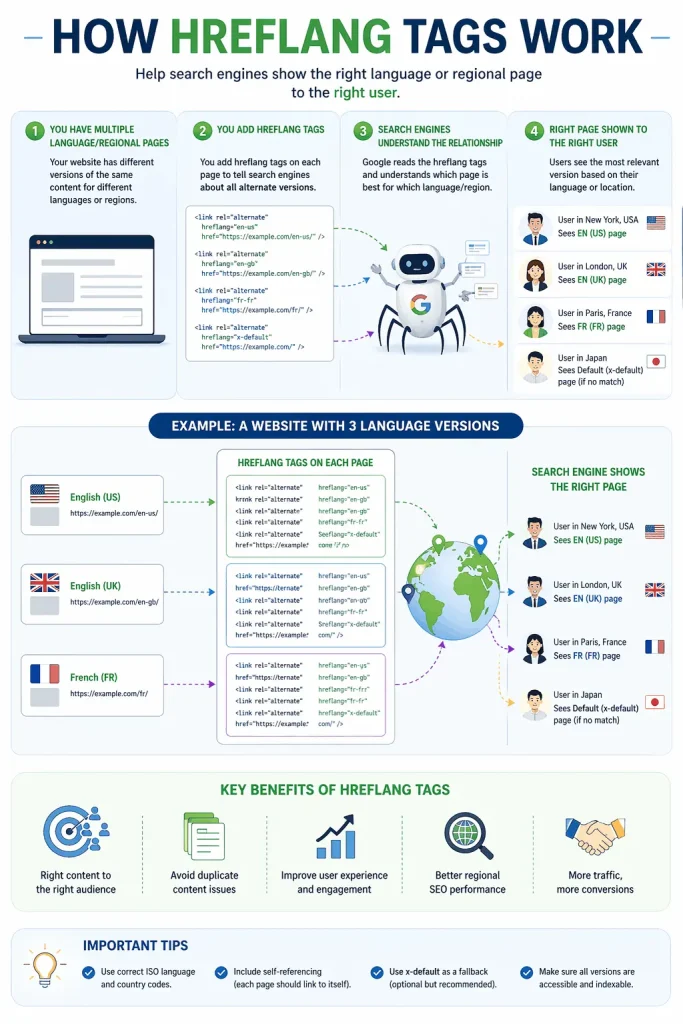
Hreflang tags are significant since they assist search engines to display the appropriate version of your page to people in other countries and languages. This enhances user experience, prevents cases of duplication of content and people are shown the correct pricing, language and content. Consequently, it can contribute to boosting traffic, interaction, and international user conversions.
The importance of hreflang tags is that it:
- Avoid duplicate content problems.
- Improve user experience
- Make sure proper regional targeting.
- Increase international rankings
- Boost conversions
In the absence of hreflang, search engines can display:
- US pages to users in the UK.
- Non-English pages to the English users.
- Wrong pricing/currency pages
Hreflang vs Canonical Tag
Hreflang tags instruct the search engines on the version of the page to display to users in the language or country. When there are similar pages, canonical tags inform the search engines of the main version of a page. To put it in straightforward terms, hreflang relates various versions, whereas canonical chooses one of the favored versions in order to prevent the problem of duplicating content.
- Feature Hreflang Tag Canonical Tag.
- Purpose Language & region targeting Duplicate page consolidation
- Use Case International SEO Duplicate content management.
- Outcome Displays the correct version on a per-user basis Picks one URL of choice.
Best Practice: Self-referencing canonical + hreflang are to be used together.
Key Hreflang Concepts
Hreflang operates on some basic principles. Every page ought to be connected to all its alternative versions (reciprocal tags) and also to itself (self-referencing). The default tag x can be used as a default page where there is no match. It is also worth using appropriate language and country codes to ensure that the search engines know that you are targeting them accordingly.
Reciprocal Tags
All other versions have to be mentioned in each page.
Self-Referencing Tags
Every page must include itself.
x-default Tag
Alternative version in the event of no match.
What Is x-default in Hreflang?
x-default in hreflang is a fallback tag to be applied in the case that no particular language or country version is a match to the user. It normally links to an international page or a language choice page. This assists in ensuring that users still get to a relevant page rather than a version that was not targeted at them due to their language or location not being explicitly targeted.
In Which Cases to use Hreflang?
Hreflang tags should be used when your site is focused on users of other languages or countries. These include multilingual websites, multi-regional websites (such as US and UK websites), international e-commerce stores offering varying prices or shipping, and localized landing pages. It assists search engines to display the appropriate version to the appropriate audience.
Use hreflang tags when:
- Your site is in several versions in other languages.
- You are attacking several nations.
- You have a global e-commerce business.
- You have localized landing pages
Hreflang Code Example
<link rel=“alternate” hreflang=“en-us” href=“https://example.com/us/page” />
<link rel=“alternate” hreflang=“en-gb” href=“https://example.com/uk/page” />
<link rel=“alternate” hreflang=“de” href=“https://example.com/de/page” />
<link rel=“alternate” hreflang=“x-default” href=“https://example.com/” />
Hreflang Implementation Methods
Hreflang implementation methods refer to how you can incorporate the hreflang tags in your web site. You may apply HTML tags in the head section of the page, XML sitemaps in the management of large sites and HTTP header in non-HTML files such as PDFs. All three approaches assist search engines to comprehend words and local versions of your web pages.
1. HTML Implementation
Added in <head> section
Most effective with small websites.
2. XML Sitemap
Centralized management
Most suitable with big websites.
3. HTTP Headers
To be used with PDFs and non-HTML files.
Common Hreflang Mistakes
Avoid these mistakes:
❌ Missing return tags
❌ Incorrect language codes
❌ URLs that have been redirected or are broken.
❌ Has conflicts with canonical tags.
❌ Using non-canonical URLs
If you make any minor mistakes can make Google disregard hreflang altogether.
Hreflang Best Practices
These best practices of Hreflang assist you in doing it right. It is important that you should always make use of self-referencing tags and ensure that every page is connected with all its alternative versions. Also use proper language and country codes, use the same URL, and only refer to canonical pages. Also, make sure that the content in the various versions is similar to enable search engines to know they are related.
Follow these best practices:
- Use self-referencing hreflang
- Have a regular URL structure.
- Use correct ISO codes
- Ensure reciprocal linking
- Use canonical URLs
Be consistent in content between languages.
- Large website Hreflang.
- E-commerce Sites
- Multiple currencies
- Regional pricing
- Shipping differences
- SaaS Platforms
- Localized landing pages
- Content Sites
- Translated blogs/articles
Best managed using:
- Automation
- XML sitemaps
- CMS integration
Hreflang vs. Other International SEO Signals
Hreflang works alongside:
- Domain Structures
- ccTLD → example.fr
- Subdomain → fr.example.com
- Subdirectory → example.com/fr/
- Geo-Targeting
Google Search Console settings (Step-by-Step)
The settings on Google Search console enable you to direct the search engine in relation to your desired audience. When you use a generic domain such as .com, you can specify a country of choice to which your site will be associated. It also assists you to track indexing, errors and performance in various regions. Although it is not a substitute of hreflang, it supplements your international SEO approach.
Step 1. Go to Google Search Console.
Log in to your Google Search Console account and choose your property.
Step 2. Go to Settings
Go to the settings menu where you will be able to control simple preferences of the site.
Step 3. Set Target Country (if needed)
In case you have a generic domain such as .com, you can select a target country to direct search engines.
Step 4. Monitor Performance
The Performance report will help you check the performance of your website in various countries.
Step 5. Track Indexing & Errors
Identify problems and rectify them using coverage and indexing reports so that they can be seen.
Step 6. Know Your Role with Hreflang.
Keep in mind that this environment will help with your SEO but not instead of hreflang, which operates at the page level.
Final Thoughts
Hreflang is also an important aspect of international SEO when your website is aimed at other countries or languages. It will assist the search engines to display the correct version of your page to the appropriate audience, which will enhance the user experience and create trust.
Properly implemented, hreflang can boost your international traffic, minimize confusion and enhance conversions. However, when done improperly, it may lead to such problems as incorrect ranking of the pages in other countries or loss of visibility.
This is why you should regularly check your hreflang configuration and make sure it is consistent with your web structure, content, and SEO strategy. Simply put, hreflang enables your site to expand in the international markets without having to compete with itself.
When properly applied,it:
-
-
- Improves user experience
- Avoids the problem of duplication of content.
- Boosts global rankings
- Increases conversions
-
However, improper use can mute your SEO.
FAQs
1. What are hreflang tags?
Ans: Hreflang tags are HTML attributes that assist search engines with displaying the right language or local form of a web page to the users.
2. What are the benefits of using hreflang tags?
Ans: The Hreflang tags enhance user experience, avoid duplicate content problems, and guarantee proper regional targeting in search results.
3. What is x-default in hreflang?
Ans: x-default An x-default hreflang value is when there is no language or region to match the user.
4. Does hreflang rank?
Ans: The relevance and user experience enhanced by hreflang are not a direct ranking factor, but lead to rankings as an indirect effect.
5. What is the result of having a hreflang error?
Ans: Wrong hreflang may lead to the following:
- Incorrect pages in incorrect countries.
- Duplicate content confusion
- Loss of traffic and conversions