

This article explains how to use SEO for Accountants to boost your rankings and attract more clients.
Let’s get to the point right here: most accounting firms are invisible at the instant that their clients are ready to hire them.
Picture the scene. You are a small business owner and received a threatening letter from the tax man. For a founder, there should be somebody who will tidy up the previous two years of neglected books before a funding round. A family suddenly finds itself in need of forensic assistance when they are selling a business. None of them go to the Yellow Pages. None of them ask their friends first.
They take out their cell phone and they look.
They search for “small business accountant near me” or query ChatGPT, “what type of accountant do I need to sell my business?” And in that three seconds, one company gets the call and the others don’t. This is the new complete game. As an accountant, SEO merely means getting your firm to show up, be trusted and get hired.
The downside is that accounting is traditionally a referral business, and many of your partners don’t think search is important to them. It does. Among the various digital marketing channels, Search is the one that reaches your target audience when they are in need of your solution. The referrals do still occur, but usually the prospect will follow up by looking you up online after to confirm the referral. Once you have a competitor that gets more exposure online, it’s a coin toss at that point.
This guide will show you how to do just that. NO fluff, NO DIY checklist theatre, just the strategy that will drive ranking and revenue on your accounting firm in 2026.
Summarize This Article With AI
Article Summary
- SEO for accountants involves optimizing your website and online presence so they can be found by people when they are searching for accounting services.
- Local SEO is the number one high-leverage channel for most businesses as 46% of all Google searches are local searches and “near me” searches account for same day calls.
- Having a complete and quality Google Business Profile is no longer a ‘nice to have’, as 88% of consumers who search a business on mobile end up calling or going to that business within a day of their search.
- On page work is really important on your money pages, which are all tax prep, audit, bookkeeping and advisory service pages that are created to match real client search intent.
- It is the technical SEO, structured data, and site speed that make the difference as to whether the above is crawled, trusted, and surfaced in AI answers.
- The new battleground is AI search. More than half (58%) of users don’t click on any organic search results anymore, making it just as important to get cited on the page as it is to be ranked on the page.
- Tracking the right metrics, leads and consults rather than vanity traffic is how you prove SEO is a growth engine and not a cost.
What Is SEO for Accountants?
SEO for accountants involves optimizing the online content and presence of an accounting firm to enhance its visibility and ranking in search engines and AI tools when potential clients search for accounting services.
“All of this is textbook.” This is the original one.
Accounting is not a product business. It’s a trust company. No one entrusts the keys to their finances, to their taxes, to their company’s books to someone they don’t trust. SEO for an accounting firm isn’t simply about ranking for a keyword. It’s about being available and the obvious competent, reliable, safe person at the exact moment someone is nervous about funds.
The mechanics are identical to any other search engine optimization: keywords, content, technical health and signals of authority. It’s the application that changes. The accounting firm is subject to seasonal peaks in the business that occur during tax filing, strict industry regulations, and professional standards, including the AICPA Code of Conduct, and the fact that the person looking up information is often stressed and skeptical.
If you get it right, search is your most predictable client acquisition channel. It works when you aren’t working, it accumulates over time, and it doesn’t turn off once you stop paying for it, as would paid ads.
Why SEO Matters for Accounting Firms in 2026
For accounting firms, SEO is important because today, when people are undertaking a buying decision, they tend to begin at the search engine and the firms that appear at the top, end up getting the lion’s share of the high intent clients.
Let’s put some numbers behind that. Almost 50% of Google searches are local, meaning that the searcher is looking for a local business or service. That’s all of your clients in that particular geographic market that are holding up their hands. And they act fast. About 88% of users who do a local search on their mobile phone will either visit or call a business within a day.
Now place the cost comparison on top. However, it’s the accounting and tax industry words that are extremely competitive on Google Ads at this time of the year, as all accounting and tax firms are bidding for the same high dollar terms in the same small window of time. Organic SEO, on the other hand, creates something that is an asset that is yours. The traffic is not eliminated as funds dry up.
Here is where it gets interesting, though.
Search behavior itself has shifted under everyone’s feet. More than half of U.S. searches (58%) do not require clicking to another site due to Google AI Overviews and answer boxes, which answer the question on the SERP. People also are asking full questions to ChatGPT, Gemini, and Perplexity rather than entering a few words into an input. They don’t want 10 blue links, they want an answer. Therefore, search visibility is not a fixed thing, as it is now, it will be seen in far more surfaces than Google.
Traditional SEO vs AI SEO Comparison for Accounting Firm
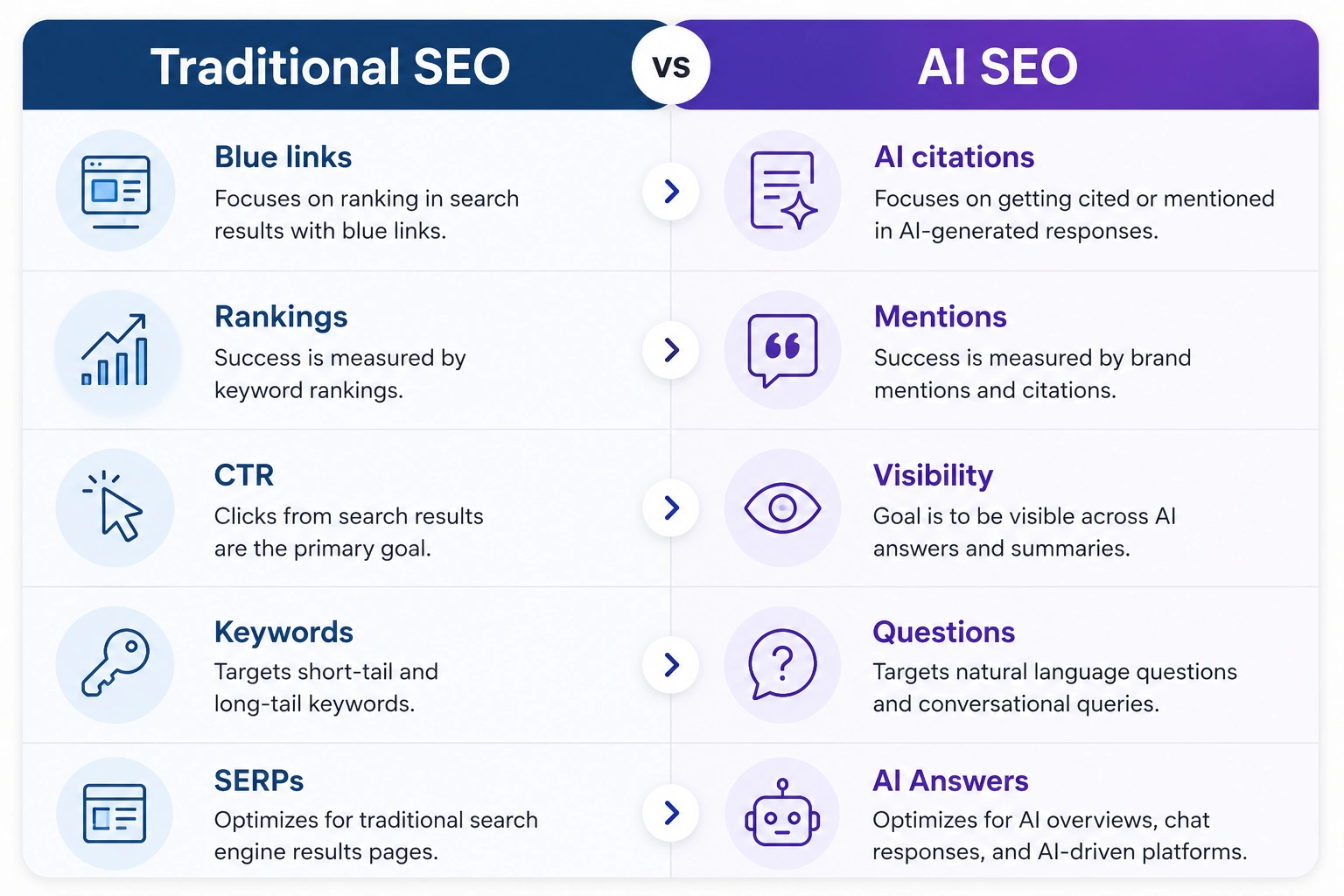
If your AI summary above the results page doesn’t include your firm, then it is worth much less than being ranked #1 on a traditional result set page. Now, being visible means being there and mentioned on Google, in the map pack, AI Overviews, and the LLM you can expect your prospects to increasingly rely on.
Those companies that grasp it are making huge strides silently. Those who haven’t gotten the memo on SEO yet are asking themselves where their pipeline went.
Keyword Research for Accountants
Accountants keyword research is the activity of determining exactly what sort of terms people are searching for whenever they are seeking accounting help, and connecting them to pages on your website.
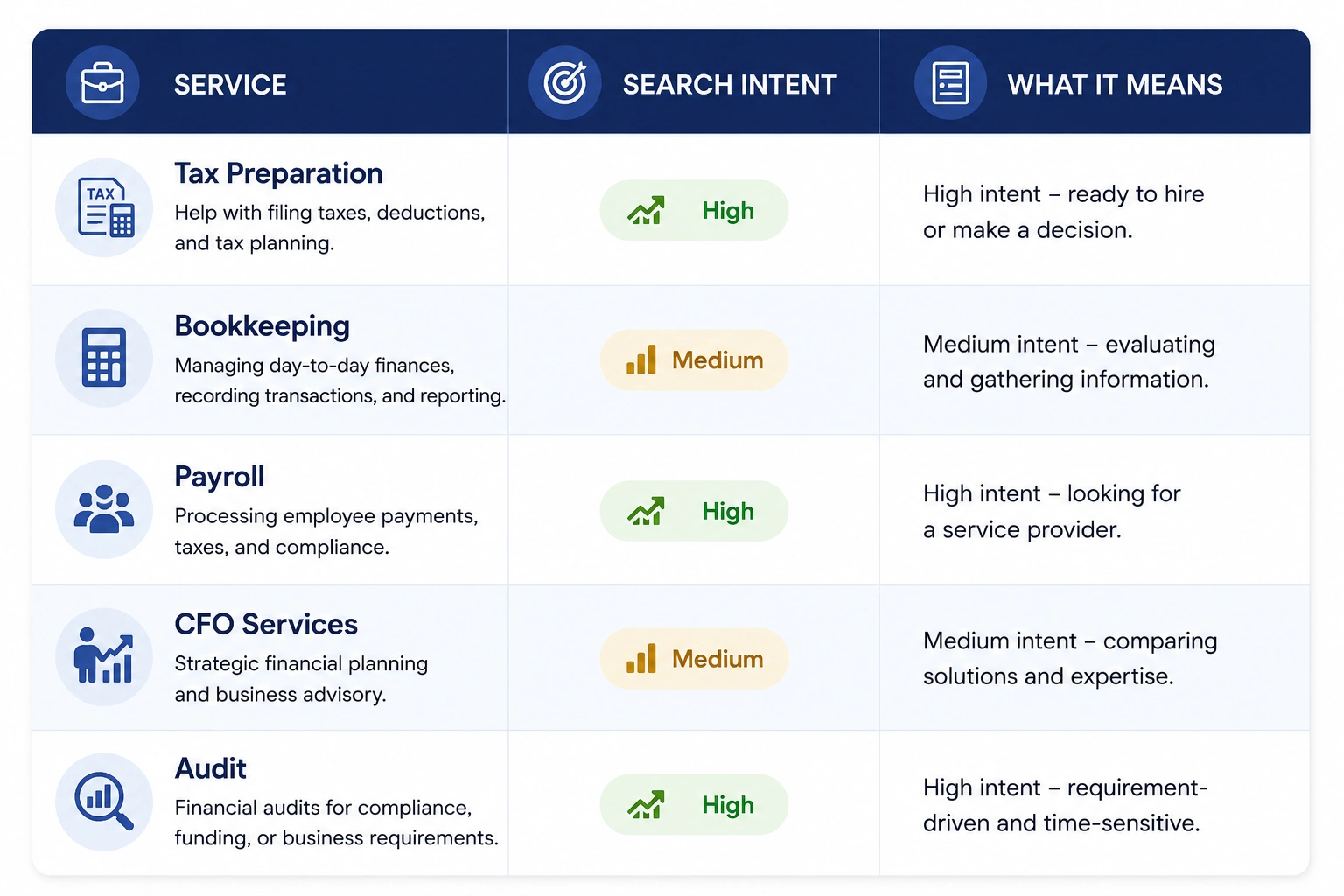
SEO Keywords Research for Accounting Firm
Most companies do this upside down. They begin with the services they wish to sell and work the keywords to match them. The correct way to begin is to recognize how people actually search, as the vocabulary of a stressed business owner is not necessarily the same as that of a chartered accountant.
Consider the ratio of intended spread. Someone who types in the words “CPA near me” is ready to hire. When a person types in “small business accountant” they’re doing a comparison. If someone is looking for the answer to the question “do I need an accountant for an LLC,” they are still learning about the business and are several months away from making a decision. All three are good, but require their own page and their own content.
There are a number of distinct, easy-to-understand buckets of keywords for accounting websites. Some of these services have terms such as tax preparation services and bookkeeping for small business. Local terms include things such as “accountant in [city]” and “CPA firm [neighborhood]”. There are the questions too, that continually get funneled into AI answers, such as “how much does a small business accountant cost” or “what’s the difference between a CPA and an accountant.” Here Google’s auto-suggest feature is a goldmine because it brings up the exact keyword phrases customers type before they complete the thought.
Google Keyword Planner is a free tool that provides you with volume and a bit of an idea of demand. Paid platforms such as Semrush or Ahrefs delve deeper into your competitor’s weaknesses and what questions to aim for. In our competitor keyword research tutorial, we get into the nuts and bolts of discovering the phrases your competitors are already ranking for, which is typically the quickest method for finding low-hanging outcomes.
Also Read: Best Free Keyword Research Tools (2026) – Find High-Ranking Keywords
One word of warning. Tax season distorts everything.
January, and April is a period of sharp increase in search volume for tax related terms, followed by dramatic decline in search volume. Smart companies make content and campaigns plans ahead of that curve, instead of finding themselves caught by surprise every year.
On-Page SEO for Accounting Websites – The Essentials.
On page SEO for accountant websites includes all of the activities involved in optimizing the content and structure of each page with the goal of helping search engines understand it and put it in front of prospects that they can trust.
This is where the real ranking takes place. Having a good profile and perfect health isn’t enough if you’re serving up pages that are thin, generic and confusing. I’m going to break it down to the three areas that are most important.
Also Read: Ten Essential SEO Factors for On-Page You Must Know
Optimizing Service Pages (Tax Prep, Auditing etc.)
Your service pages are your money pages and each should be unique and dedicated to a single service with its own URL.
The big sin is the kitchen sink type of page that quickly summarizes tax, audit, book keeping, advisory and payroll in a single sentence. Google doesn’t know what this page is about and a prospect doesn’t know either. Split them. A tax preparation webpage ought to focus only on tax preparation, reflect the vocabulary of a stressed out client, reply to the obvious questions with respect to the process and the price, and clearly state the following step. That’s where content copywriting is valuable and a little bit of persuading copywriting is a booked consultation.
Cosmetics are not the only thing that differentiates between a tax prep page and an audit service page. The prospect of audit is typically served by a bigger entity which has compliance pressure and a procurement process. The tax prep prospect may be a sole trader who is seeking some reassurance and a quick answer with regards to cost. Same firm, completely different search intent, completely different page.
SEO-Friendly Blog Content Ideas for Accountants
The best blog content for accountants is the content that addresses the questions that clients are asking before they even pick up the phone.
Ignore the bland “5 tax tips” articles that have been around since 2012. Content that is ranking, topical is answering specific, timely questions. Enhance your blog posts with clarity and usefulness by incorporating think pieces on the implications of the Tax OBBB Act for small businesses, how to make tax digital, how a legal and compliance change just landed, or a grounded perspective on what AI means in accounting for your clients.
This type of content works double duty. It attracts informational searchers at the beginning of the funnel, and it makes your company the authority who gets it. It’s in fact exactly the material that the AI can love to quote, and that is what boosts your search engine exposure! The key to both organic SEO and AI citations is not an add-on – it’s a robust content strategy.
Read more: 10 Best Content Writing Tools to Boost Productivity & Rankings
Title Tags, Meta Descriptions, and Header Usage
On page factors that inform search engines about the content of a page and encourage visitors to click are: Title tags, Meta descriptions, Header tags.
The meta title and meta description are your storefront in the search results. A title that explains to search engine users what you’re actually offering, such as “Tax Preparation Services in Austin | [Firm Name] CPA”, will do more than just a generic ‘Our Services’ ever could on Google SERPs, and it will affect how your listing reads. While the meta description doesn’t directly affect rankings, it can make a huge difference in whether someone clicks or not—and that certainly has an impact.
Use header tags to organise the page for readers and for crawlers. Using a clean hierarchy of H1, H2, and H3 headings can assist Google in understanding your content and enable AI systems to find clean answers from your content.
Local SEO for Accountants
Local SEO for Accountants is the technique of making your internet appearance much more prominent in your service areas.
It is the most leveraged work that you can do for the majority of companies, that’s the end of the story. If a local accountant is involved in the search query, such as “accountant near me” or “CPA in [city]”, Google displays a map pack with three local results first, before the regular organic results. The local 3-pack is likely to capture a significant portion of clicks and calls for most of the local intent searches, and is often more rewarding to land in than be in the top spot for the blue links below it.
This is where the shock comes in. Local SEO is a unique niche with its own ranking factors, and simply having a pretty site won’t do the trick. The three principles listed below take care of the bulk of the work.
Must Read: How to Create and Rank Google Business Account by SEO: Guide?
Google Business Profile Optimization
The most important key to local visibility is your Google Business Profile (aka Google My Business) and if it’s incomplete, that’s the most common reason that businesses don’t show up in the map pack.
Fill in all fields and claim it and verify it. Proper categories, hours, service areas, photos of your office and staff, and a description that accurately expresses your business. This is especially important as a full profile can increase the likelihood of a customer trusting a business by 2.7 times, and trust is all the ruckus in accounting.
Don’t leave the profile as an asset that sits there and stays there. It’s also the same thing that gets you placed on Google Maps if someone searches for you, as it is the same as providing good customer service before anyone even calls. Post and answer inquiries and maintain up to date information. Post updates, answer questions, and keep the information current. Google rewards active, complete profiles, and so do prospects.
Local Citations and Reviews
The trust signals that are most important for Google to see and determine that your firm is real, established, and worth ranking locally are local citations and online reviews.
Citations are references to your company’s name, address and phone number in directories and industry listings. It is crucial that it is consistent. Reviews on the other hand, are both ranking and conversion factors. These are read by prospects with obsession – before they even reach out to an accountant they are reading these.
Also Read: How to Leave a Google Review for a Business
Always seek feedback from happy customers and follow up on all the feedback you get – both positive and negative. A well-formulated answer to an “in-depth” review is more likely to convert: it demonstrates a problem-solving attitude.
NAP Consistency and Location Pages
NAP consistency is the basic ingredient of local ranking; it is the basics of your Name, Address, and Phone number that is consistent across the web.
Google slowly loses faith in your listing when its data doesn’t match what is on the page. Check and correct citations. If you have more than one office, create a solid location page for each office, instead of making flaky copies. Each location page should have localized content, the specific office information, and preferably local proof points, to gain its rank in local search results, not simply sit there.
Link Building and Authority for Accounting Firms
Link building for accounting firms is the process of getting links from other trusted sites to increase your domain authority and build your website credibility with search engines.
Consider links as “votes of confidence. Google recognizes that your site is credible when a trusted directory or industry publication or local business association links to your company. This authority layer has more weight in the financial sector, where trust is of paramount importance.
Here are tactics that work: boring and durable. Legitimate business listing in the business directories and accounting industry bodies. Guest articles to respected finance and business journals. Mentions won on merit, such as commenting on an article in the newspaper about a change in the tax laws. Sponsorships and partnerships with local organisations, which create a natural and editorially appropriate link.
The thing you don’t want is the low quality stuff. There’s no need to purchase links from low quality networks as this will quickly get you a penalty and in a regulated niche, where trust is paramount, buying links is not worth it.
You Also Like This: AI Link Building Tools (2025): BacklinkGPT vs Other Features, Pricing, Comparison
Niche relevance has prevailed over raw volume time and time again. A hundred links from a random blog, not related to finance, will not help your website’s authority quite as much as ten links from an accounting blog or a local business blog, and when it comes to website authority, that’s what counts.
Technical SEO for Accountants
Technical SEO for Accountants is behind-the-scenes efforts that ensure search engines can crawl, render, and trust your website.
You may have the very best content in your market but if Google can’t access it, then no content ranks. This is the plumbing and accounting firms rarely bother with it since clients have no way of knowing. It’s not hidden from search engines.
Begin by starting with the basics that impact all customers. Your site must be fast: Page speed and Core Web Vitals are known ranking factors and a slow site leaks prospects. It must be truly “mobile-friendly” because most local searches are conducted on a mobile device, and a poor mobile user experience leads to a high bounce rate and prospects going directly back to a competitor. It should also have HTTPS security, which is another ranking indicator and a standard for every company dealing with financial data.
There’s also the crawlability layer. Optimized URL structure, logical internal link structure that distributes authority to your money pages, a valid XML sitemap, regular crawl error checking and proper canonical tags to prevent duplicate content confusion. If the metadata is clean in all templates, it makes the entire thing readable to crawlers. None of this is glitzy, but it’s the distinction between a site that Google can read the moment it loads and one that it has to struggle to comprehend.
Another is becoming more and more significant and worth its mention. Schema markup is a type of structured data that provides search engines with clear, machine-readable data about your company, typically under the guise of a Local Business or a Professional Service. Structured data is one of the better methods to ensure that your firm’s information is easily understood and quoted by AI systems that are able to extract and summarize content. There’s our structured data guide that teaches you how to use it correctly.
Measuring SEO Results: Key Metrics to Watch
For an accounting firm, SEO success needs to be measured not by vanity metrics, but by those that can be used to help drive revenue.
This is where so many companies go wrong. Traffic is progress, but traffic that doesn’t ever turn to a consultation is noise. The metrics that really count “ramp up” to business outcomes.
Keep an eye on the ranking positions of the high-intent terms indicating buying intent, as well as the “near me” and service-plus-city searches. Use Google Search Console to monitor & measure organic impressions and clicks to understand what you are bringing up and where you are losing clicks. Most importantly, monitor conversions: form fills, phone calls, and booked appointments. That’s where call tracking software can prove its value as so many accounting inquiries come in on a phone call versus a form.
Google Analytics gives you insights into what your website visitors do after they get there, where they leave your site, and which pages generate contacts. Google Search Console gives you a view of the Google’s website, what search queries you rank for, and any crawl issues that are blocking you. Together they tell you if your SEO is creating a pipeline or it’s creating page views.
The goal is simple. You need to be able to highlight organic search and confidently say, “This channel generated these number of qualified leads in this quarter. That’s what makes SEO more than just an item on the bill—it becomes a growth machine.
Here are some of the common SEO mistakes that accounting firms should steer clear of.
The quickest way to boost your firm’s SEO is to cease doing the little things that are slowly harming your firm’s ranking. These are some of the common errors that are observed.
Ignoring Local SEO
The number one mistake is assuming local search is a secondary channel, and this is the top-most intention channel a company has.
Companies invest time in a slick website, but never claim or optimize their Google Business Profile. They wonder why “accountant near me” directs all leads to the competitor down the street. If you have time, just do one of these things from this guide: set up your local presence.
Publishing Thin, Generic Content
Any text that doesn’t aim for a specific keyword and is too thin is not going to catch anyone’s attention or improve the ranking.
A few three-sentence pages and a ten-year-old blog will never match up. Google is rewarded with depth, expertise and usefulness. So do prospects when they’re considering you for their money. A generic content indicates a generic company.
Neglecting Technical Health
Slow, non-mobile, and crawl error-infested sites are the death knell for all other efforts.
You may be able to write great content and gain amazing links, but if the technical foundation is not sound, rankings will come to a standstill. Technical SEO is not something that your clients can see, but it is very visible for Google. Don’t ignore it, at your own risk.
Forgetting About AI Search
The latest and most expensive blunder is optimizing for only traditional rankings and ignoring AI search.
Most of the customer questions are now answered within AI Overviews, and increasingly, prospects are consulting ChatGPT and Gemini directly, leaving a company behind. A company that’s not in the answers is not in the future of search, since the majority of questions are now being answered within AI Overviews and more and more prospects are now consulting ChatGPT and Gemini directly. To remain citable, you will need to have structured content, clear answers, and authority signals.
How to Choose the Best SEO Agency for Accountants
When deciding on an SEO agency for accountants, you need to look for someone who also understands the nature of the financial industry and the trust that people depend on in that sector, which is regulated.
There are many agencies who can tell you the fundamentals of SEO. Much fewer realize that digital marketing for accountants is a discipline unto itself, with a trust-based selling process, a seasonal demand curve, and ethical guidelines that dictate what and what not you can claim. What distinguishes a real partner from a vendor is the content in terms of matching reality and not generic agency boilerplate. That context matters.
Find an agency that doesn’t just report on ranking but on leads and revenue as well, one that can demonstrate real results in finance-related niches, and one that sticks to white-hat SEO only – a penalty in a niche that trusts is a costly one to overcome. Ask to see case studies. Inquire what they consider successful outcomes to be. Inquire if they do anything beyond the superficial changes in technical health, content and website design? Ask them what they think they would do in the first 90 days. A local accounting firm will have varying requirements as compared to a national accounting firm, and the ideal partner will be able to identify the difference.
The correct partner doesn’t bother with rankings. They create a search portfolio that adds up to a solid, year-round client acquisition stream, and your pipeline isn’t reliant on tax season anymore.
How SEO is a long-term growth engine for your firm.
Accountant SEO is not a one-off task or a seasonal campaign. Is a long-term growth engine compounding.
Each optimized page, online link and answered question adds up to the previous. Websites need to be effective and of high quality to stay consistent in search engine results, and with Google’s algorithm changes, things can shift overnight. After 6 months, you begin to see results for the keywords you have targeted. This is the case because topical authority does that, and you are showing up in queries you haven’t targeted even one year into your blog. Despite it being a market that’s been around for two years, you can expect the organic leads to arrive quietly as your competitors continue to purchase clicks at tax season and hope for the best.
That’s the actual jackpot. It isn’t a short-lived traffic spike – it’s an asset that makes your firm the natural, reliable answer when your clients are looking on Google, the map pack, and even when they ask a question to your AI tool first.
Don’t wait for the change to AI-powered search. It is an incentive to get moving before most of your business competitors wake up. The accounting firms who will win the coming several years are the ones who are creating visibility where their clients are looking now.
If you’re looking for a partner who leverages search and translates it into quantifiable growth for your firm, schedule a free discovery call. We’ll give you the specifics on where opportunities lie and how to catch them.