

In 2026 to be ranked on Google, learning how to use on page SEO tools and on page SEO optimization is no longer an option- it is the key to long term organic growth. The search engines have now moved beyond matching keywords and are now more focused on search intent, content quality, and other real user experience (UX) indicators such as engagement, page speed, and relevance. It implies that all the items on your page, such as title tag optimization and meta descriptions, internal linking strategy and the readability of your content, need to collaborate to create value.
Be it a novice looking to learn about the fundamentals of on page SEO or an expert marketer looking to ramp up traffic, this guide will take you through the top on page SEO tools, a time-tested on page SEO optimization checklist, and practical, step-by-step methods of improving your rankings. You’ll also learn how to leverage semantic SEO, NLP keywords, and intent-based optimization to stay ahead of competitors.
Regardless of your level of expertise as a marketer, this guide will enable you to comprehend:
 What is On Page SEO?
The most effective on page SEO tools.
An on page SEO optimization checklist.
Step-by-step strategies to improve rankings
How to optimize content using semantic SEO & search intent
On page SEO optimization is the optimization of a single web page to enhance rankings and user experience.
It includes:
Content optimization
HTML elements (title tag, meta description)
Internal linking
Page performance and UX.
This is 100% within your control unlike off-page SEO.
What are On Page SEO Tools?
On page SEO tools are software applications that aim at optimizing individual web pages to enable improved search engine ranking and user experience. They help to enhance important aspects like content quality, meta tags, position of keywords and internal linking structure. Technical aspects such as page speed, mobile friendliness, and the performance of overall SEO are also analyzed with the help of these tools, and it becomes easier to detect problems and adopt powerful optimization methods.
What is On-Page SEO Optimization?
On-page SEO optimization is the process of enhancing the individual web pages to appear higher in search engines and receive pertinent traffic. It entails the optimization of such aspects as titles, meta description, headings, content, keywords, internal linking, and images. Effective on-page SEO allows search engines to get to know more about your content, and improves user experience and visibility.
Explore our complete guide on Best Free SEO Tools List (2026)
Why On Page SEO is Important in 2026
The optimization of page SEO is essential in 2026, as Google is focused on the search intent, content quality, and real user experience (UX) indicators, such as page speed, and engagement. On page SEO tools, optimized title tags, and good internal linking can be effectively used to enhance visibility, ranking, and make sure your content is well-suited to the changing demands of the algorithm.
Search engines are smarter now. Google focuses on:
Search intent optimization
Content quality
User experience (UX)
Core Web Vitals
If your page lacks:
- Proper keyword placement
- Strong internal linking strategy
- Optimized header tags (H1, H2, H3)
You will struggle to rank—even with backlinks.
Get Free Access of On-Page SEO Tools (Free AI Tool)
No login required • Instant access • 100% Free
Best On Page SEO Tools (Free & Paid)
The right on page SEO tool is faster, data-driven and more effective when it is used to optimize. To use free tools, Google Search Console is useful in tracking performance and SEO audit reports, and PageSpeed Insights enhances page speed optimization and Core Web Vitals. WordPress users can use plugins such as Rank Math and Yoast SEO as on page SEO checker tools.
To go deeper, there are paid tools such as SEMrush and Ahrefs that provide powerful on page SEO analysis tools, competitor analysis SEO and site audit tools. In the meantime, Surfer SEO and Frase focus on content optimization tools SEO, which can be used to enhance the quality of the content, the use of keywords, and the overall SEO rating.
Here’s a curated on page SEO tools list for better optimization:
Free On Page SEO Tools
Google Search Console (SEO audit report & performance)
Google PageSpeed Insights (page speed optimization)
SEO Minion (on page seo checker)
Rank Math / Yoast (WordPress on page seo tools)
Paid On Page SEO Tools
SEMrush (on page seo analysis tools + competitor analysis SEO)
Ahrefs (site audit tools + keyword tracking)
Surfer SEO (content optimization tools SEO)
Screaming Frog (technical + on page audit tools)
These tools help generate:
- SEO score checker reports
- Website optimization insights
- Content readability score
- Complete On Page SEO Optimization Checklist
| Tool | Type | Use |
|---|---|---|
| SEMrush | Paid | SEO audit |
| Ahrefs | Paid | Backlinks |
| GSC | Free | Performance |
Free Access of On-Page SEO Tools (Free AI Tool)
No login required • Instant access • 100% Free
Check out all other SEO Tools Here:
Step-by-step on page SEO optimization checklist:
Title Tag Optimization
One of the most important on page SEO optimization factors is your title tag. It must contain your main keyword such as on page SEO tools and must be less than 60 characters. An attractive and catchy headline also increases CTR, which has a direct influence on your search performance.
✔ Insert main keyword (on page seo tools).
✔ Limit it to less than 60 characters.
✔ Make it click-worthy
The Tools to Use: Google Search Console, SEMrush, Ahrefs, Yoast SEO / Rank Math.
Meta Description Optimization
A properly composed meta description is beneficial to increase the visibility and click-through rates. Apply the secondary keywords intuitively and make it not more than 150-160 characters. Make it interesting, valuable and user intent to gain more clicks through the search results.
✔ Include secondary keywords in a natural manner.
✔ Make it less than 160 characters.
✔ Focus on CTR
Tools to Use: Google Search Console, SEMrush, Ahrefs, Yoast SEO / Rank Math.
Header Tags (H1, H2, H3)
Appropriate use of the header tags enhances readability and SEO. Your H1 must present the topic clearly, and H2 and H3 must present the content logically. The inclusion of keywords in the headings assists the search engines to comprehend your contents better and increase relevance.
✔ Use proper structure
✔ Insert keywords in H2/H3.
✔ Improve readability
Keyword Placement & Density
On page SEO optimization requires strategic placement of keywords. Insert your main keyword in the title, first 100 words and H2 tags. Keep the natural density of the keywords and do not stuff your content with keywords to make your content user-friendly and optimized.
Use primary key in:
✔ Title
✔ First 100 words
✔ H2 tags
✔ Keep natural density of keywords.
✔ Avoid keyword stuffing
Tools to Use: Screaming Frog, Ahrefs Site Audit, SEMrush, SEO Minion.
URL Structure Optimization
A clear and simple URL system enhances the SEO and user experience. Make URLs concise, easy to read and add your key word. As an example: on-page-seo-tools is straightforward, concise, and has a higher potential to be found in search engines.
✔ Use short and clean URLs.
✔ Example: /on-page-seo-tools
The Tools to Be Used: Screaming Frog, Ahrefs Site Audit, Google Search console, Rank Math / Yoast.
Content Optimization (Most Important)
The essence of on page SEO is content. Concentrate on content of high quality that is valuable and meets user intent and semantic SEO. Use applicable keywords in a natural way, keep it readable and make sure that your content is able to give the user what he or she is querying.
Focus on:
✔ Content quality
✔ Semantic SEO
✔ Keyword intent matching
The content you provide should meet:
✔ Informational intent
✔ Business intent (where applicable)
Tools to Use: Surfer SEO, Frase, Grammarly, Hemingway Editor, SEMrush Writing Assistant.
Internal Linking Strategy
A sound internal linking plan will ensure search engines crawl your site more effectively, and comprehend the relationship of content. The connection with the corresponding pages disseminates link equity and enhances indexing. It is also useful in creating high topical authority, maintaining user engagement and extending the time of session.
✔ Connection to other pages.
✔ Improve crawlability
✔ Build topical authority
The tools to be used: Screaming Frog (crawl analysis), Ahrefs (internal link opportunities), Google Search Console (link report).
Image Alt Text Optimization
Image alt text should be optimized to enhance accessibility and SEO. Include descriptive and easy to understand alt tags that describe the picture and at the same time have the keywords that are relevant to the image. This assists the search engines in comprehending the contents that are in the form of images and can also generate traffic on the image search results.
✔ Use descriptive alt tags
✔ Add keywords naturally
✔ Improve accessibility
The tools to be used include Screaming Frog (image audit), Ahrefs Site Audit, Rank Math / Yoast SEO (WordPress optimization).
Page Speed Optimization
Speed of the page is an essential rank factor and has a direct effect on the user experience. Image compression, CDN, and reduction of unnecessary JavaScript and CSS files. The quicker the page loads, the less frustration there will be, the more active the page will be, and the better on page SEO will be.
✔ Compress images
✔ Use CDN
✔ Minimize JS/CSS
Impacts:
✔ Bounce rate
✔ Dwell time
Optimized pages are faster and offer enhanced user experience, which reduces bounce rate and dwell time. The longer users interact and stay, the better it is signaled to search engines, which enhances your rankings and general SEO rating.
The tools to be used: Google PageSpeed Insights, GTmetrix, Lighthouse (Chrome DevTools).
Mobile Friendliness
Having a responsive design is needed with most of the traffic being mobile. Make sure that your site is responsive to various screen sizes and test on various devices. A mobile-friendly site enhances usability, engagement, and search positions.
✔ Use responsive design
✔ Test on multiple devices
The tools to be utilized: Google Mobile-Friendy Test, BrowserStack (device testing), Chrome DevTools (responsive view).
Basic Web Vitals Optimization.
Core Web Vitals are key performance metrics that impact rankings and user experience. Work on LCP (loading speed), CLS (layout stability) and FID (interactivity). These are the things that should be optimized to make your site fast, stable, and user-friendly, which are among the ranking signals of Google.
Focus on:
✔ LCP (Loading speed)
✔ CLS (Layout shift)
✔ FID (Interactivity)
The tools to be used include: Google Search Console (Core Web Vitals report), PageSpeed Insights, Lighthouse.
How to Do On Page SEO Step by Step:
Begin with keyword research where the key words and LSI keywords are determined then the competitors are analyzed using SEO tools. Produce quality content that matches the intention of the search, and optimize title tags, meta description, headings and URL structure. Include internal links, optimize pictures, and enhance page speed. Lastly, page SEO audit tools to monitor performance and optimize further.
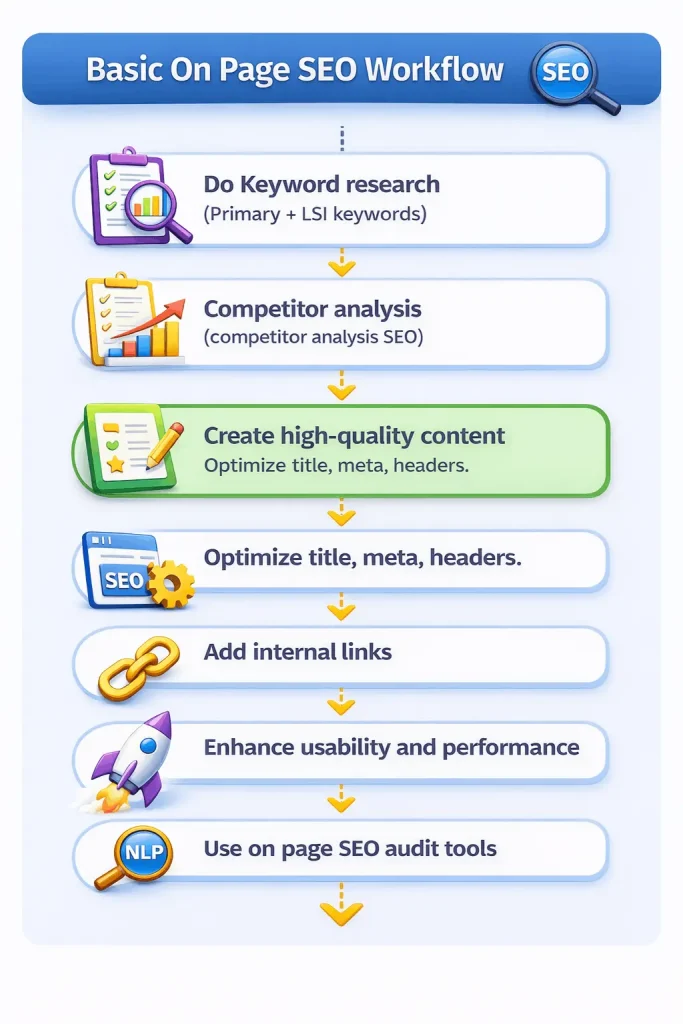
The following is a basic workflow.
Do Keyword research (Primary + LSI keywords)
Competitor analysis (competitor analysis SEO)
Create high-quality content
Optimize title, meta, headers.
Add internal links
Enhance usability and performance.
Use on page SEO audit tools
Improve Your Website On-Page SEO (Free AI Tool)
No login required • Instant access • 100% Free
On Page SEO Techniques (2026)
The next level of on page SEO optimization in 2026 is beyond the fundamentals, as it is concerned with semantic SEO, mapping search intent, and topical authority. Optimize featured snippets, use NLP keywords, and design content to be searched by AI (SGE). Freshness: Continuously refresh content, Enhance UX indicators: dwell time, Data-driven optimization: use specialized on page SEO tools.
Semantic SEO
Semantic SEO is concerned with the use of NLP keywords and addressing the related topics to provide a full context to search engines. Rather than optimizing a single keyword, create topical depth such that your content can respond to several related queries and boost overall rankings.
✔ Use NLP keywords
✔ Cover related topics
✔ Build topical depth
Search Intent Optimization
Search intent is about making sure that what you write is what users are searching. Make your content relevant to informational and transactional queries that will meet the needs of users and increase engagement and conversions.
Match content with:
✔ Informational queries
✔ Transactional queries
Content Freshness
Frequently changing the content sends an indication to the search engines that your page is current and important. Include new information, examples, and knowledge to increase rankings and stay in control of the search results.
✔ Revise out-of-date material.
✔ Include new information and knowledge.
Content Readability Score
Increasing readability will improve user experience and engagement. Easy to scan and understand your content should be done using short paragraphs, bullet points and simple language, which also helps eliminate bounce rate.
✔ Use short paragraphs
✔ Add bullet points
Improve UX
Enhancing user experience (UX) is crucial to improved rankings and interaction. Pay attention to quick loading websites, simple navigation, and mobile-friendliness. The ease of UX minimizes bounce rate, dwell time, and sends search engines positive signals.
On page example SEO.
Poor Optimization:
Poorly optimized pages are those that do not use keywords properly, contain thin or weak content and do not provide internal linking. This renders search engines to have a hard time comprehending the page and leads to poor ranking and user interaction.
✔ No keywords
✔ Weak content
✔ No internal links
Good Optimization:
Properly optimized pages have an optimized title tag, effective placement of keywords and enticing meta description. This coupled with high loading speed and mobile-friendly design enhances visibility, user-friendliness, and overall SEO performance.
✔ Correct title tags optimization.
✔ Strong keyword placement
✔ Optimized meta description
✔ Fast loading + mobile-friendly
Best Free On Page SEO Tools for Beginners
Google search console, page speed insights and Rank math are more than sufficient in case you are just beginning with on page SEO optimization. They assist you in carrying out simple SEO audit functions, detect problems, and in general enhance your overall on page SEO rating without incurring any expenses, thus they are ideal to beginners.
You can start with:
✔ Google Search Console
✔ PageSpeed Insights
✔ Rank Math
These suffice to:
✔ Perform basic SEO audit tools free
✔ Enhance on page SEO score.
Looking for On-Page SEO Tools ( Get Free Access of AI Tools)
No login required • Instant access • 100% Free
SEO Checklist for Blog Posts:
It is essential to adhere to a correct on page SEO checklist before posting any blog. Make sure that your title tag and meta description are optimized, that keywords are put in their appropriate places and that internal links are included. Also, compress images, test page speed, and ensure that your content meets search intent to achieve higher rankings.
Before publishing, ensure:
✔ Title tag optimized
✔ Meta description added
✔ Keywords placed properly
✔ Internal links added
✔ Images optimized
✔ Page speed checked
✔ Content is relevant to search intent.
What to Do to increase the Page SEO Score?
To enhance your on page SEO score, you need to keep on optimizing it. Check page SEO checker tools to determine the gaps, address technical problems, and improve content depth. Concentrate on enhancing user experience indicators such as page speed, readability, and interaction in order to attain higher rankings.
✔ Use on page SEO checker tools
✔ Fix technical errors
✔ Improve content depth
✔ Optimize UX signals
Tools to Optimize Website Content
Best tools for content optimization:
To optimize content, such tools as Surfer SEO and Frase assist in using keywords and NLP recommendations, whereas Grammarly assists in making the text easier to read and understand. These are the tools that will see to it that your content is properly structured, search engine optimized and user intent to improve performance.
✔ Surfer SEO
✔ Frase
✔ Grammarly (readability)
Frequently Asked Questions (FAQs)
1. What are on page SEO tools?
On page SEO tools help analyze and optimize individual web pages for better rankings. They provide insights on content quality, keyword usage, meta tags, internal linking, and overall SEO performance.
2. What is on page SEO optimization?
On page SEO optimization is the process of improving elements like content, title tags, meta descriptions, URLs, and internal links to make a webpage more search engine and user-friendly.
3. Which are the best free on page SEO tools?
Some of the best free tools include Google Search Console, PageSpeed Insights, and Rank Math. These tools help with SEO audits, performance tracking, and basic optimization.
4. How can I improve my on page SEO score?
You can improve your score by optimizing content quality, using proper keyword placement, fixing technical errors, improving page speed, and enhancing user experience signals like dwell time.
5. What is the difference between on page SEO and technical SEO?
On page SEO focuses on content and page elements like meta tags and keywords, while technical SEO deals with backend factors such as site speed, indexing, and crawlability.
6. How important is search intent in on page SEO?
Search intent is crucial because Google prioritizes content that matches what users are looking for. Aligning your content with user intent improves engagement, rankings, and conversions.
Final Thoughts:-
Mastering on page SEO tools and on page SEO optimization is key to achieving long-term success in search rankings. By following best practices, using the right tools, and focusing on user intent, you can consistently improve visibility, drive traffic, and grow your website effectively in 2026 and beyond.
If you:
Follow the checklist
Use the right tools
Focus on user intent
You’ll see consistent growth in traffic and rankings.
Also Read:
What are Two Ways Optimization Score can help Marketers Succeed
Top 10 Best SEO Experts in India 2026
How often does Google Maps update?
Delete a Facebook Page (Step-by-Step Guide)
Top 10 AI Marketing Automation Tools
How to Access Grok 3/4.1 AI: A Step-by-Step Guide