

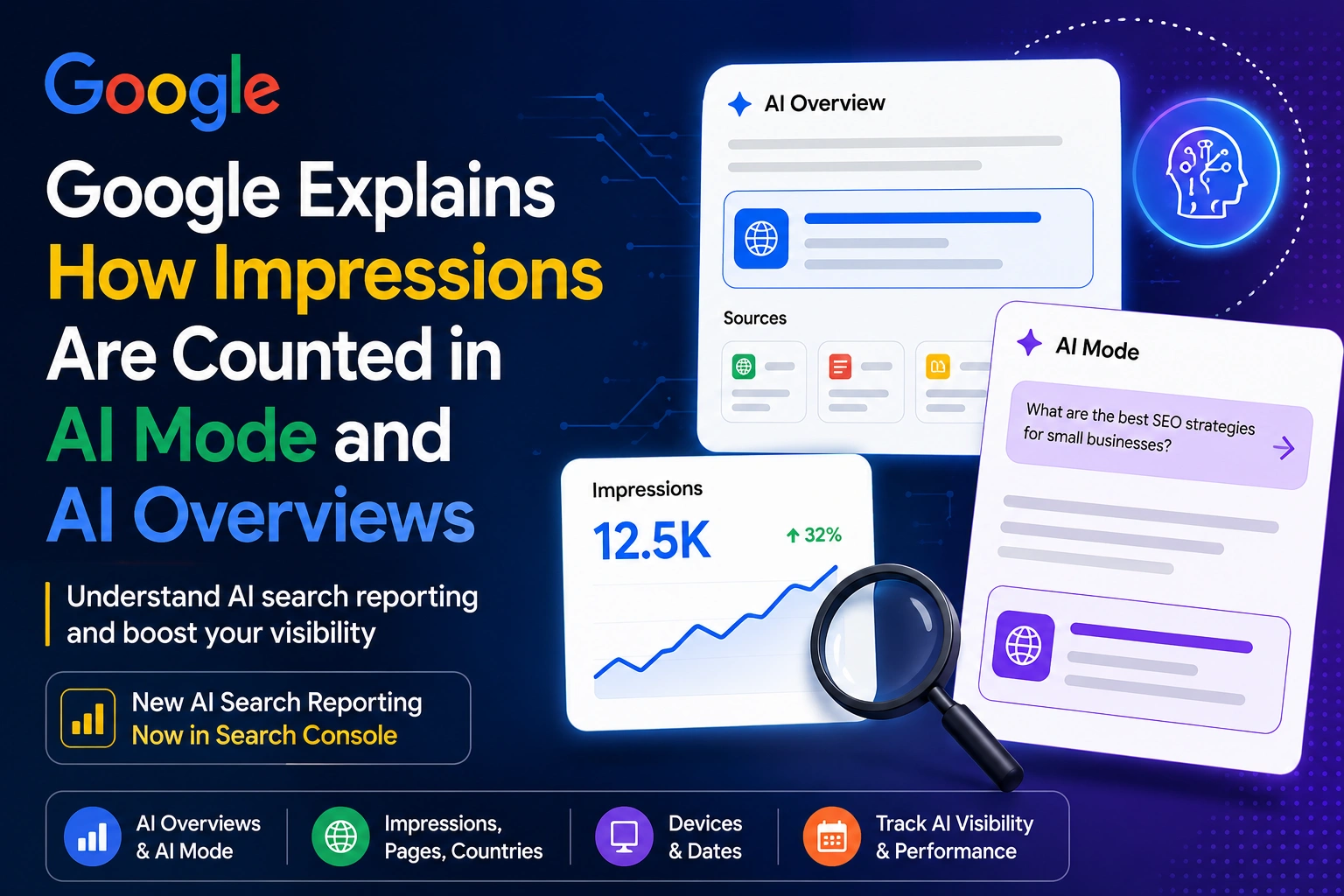
Google has clarified how impressions are counted when websites appear in AI Overviews and AI Mode, giving SEO professionals a clearer picture of AI search data in Google Search Console.
The clarification is important because an appearance in an AI-generated answer does not necessarily equate to an impression. Google’s measurement is based on how a link to a website is displayed and whether the user needs to interact with the search experience to view the link.
In June 2026, Google introduced its new Search Generative AI performance reports, offering website owners new visibility data on generative AI features in Search. Reports include impressions, pages, countries, devices, and dates for content that is displayed in AI features.
However, what constitutes an impression?
Does every reference, website icon, citation or concealed link within an AI answer count?
The following are the things that website owners and SEOs should know.
Summarize This Article With AI
Quick Takeaway
Google’s new Generative AI performance reporting gives SEO professionals a clearer way to understand how their websites appear in AI-powered Google Search features.
The most important thing to remember is that an AI-generated mention is not automatically the same as an impression. Search Console measures impressions based on qualifying links to your website appearing in generative AI features.
For AI Overviews, Google says a link must be scrolled or expanded into view to count as an impression. For AI Mode, standard Search Console impression rules apply.
This means SEO professionals should distinguish between:
- Brand mentions
- AI citations
- Website URLs
- AI impressions
- AI-generated clicks
- Organic traffic
- Business conversions
The new report is therefore useful for understanding AI search visibility, but it should not be treated as a complete measurement of every time an AI system mentions your brand.
Key Points at a Glance
- AI Overviews and AI Mode are included in Google’s Generative AI performance reporting.
- AI Overview links must be scrolled or expanded into view to count as an impression.
- Standard impression rules apply to AI Mode.
- A brand mention without a qualifying website link is not automatically a Search Console impression.
- AI Mode follow-up questions are treated as new queries for Search Console measurement.
- AI visibility should be measured alongside clicks, traffic, leads and revenue, rather than impressions alone.
What Is the New Generative AI Performance Report?
Google’s Search Console has a new section dedicated to visibility in generative AI features.
The new reports are used to illustrate the frequency of URLs from a website appearing in AI-powered features in Google Search and Discover. Google states that features such as AI Overviews and AI Mode are included in the Search report.
The report can contain information such as:
- Impressions
- Pages displayed in AI features
- Countries
- Devices
- Dates and performance trends
Google started to roll out the reporting gradually instead of making it available to all websites at once.
This is an important development for SEO because it provides insight into how frequently content appears within Google’s generative AI experiences, something that was not captured as clearly by traditional Search Console reporting.
The report is by no means a comprehensive AI search attribution system, however.
Currently, it primarily provides information regarding visibility, but it doesn’t give marketers every piece of information they might need, such as the exact AI prompt that triggered an appearance or a complete breakdown of clicks generated by each individual AI response.
What Counts as an Impression in AI Search?
The most crucial point is simple:
An impression is associated with a qualifying link to your website appearing in an AI search result.
It is not simply about the number of times your brand, business or website is mentioned in an AI-generated response.
Google’s general definition of an impression in Search Console is based on a user seeing, or potentially seeing, a link to a site in Google Search. The specific visibility requirement varies depending on the type of search result.
With AI Overviews, that distinction becomes even more relevant.
For instance, Google produces an AI Overview that talks about several SEO tactics and links to your website as one of the supporting sources.
If this link meets Google’s impression requirements, it can generate an impression for your URL.
But if your website is merely discussed in the text without a qualifying link to your page, that does not mean you automatically receive an AI impression.
This is one of the biggest points SEOs should understand when assessing AI visibility.
Understanding How Google Counts Impressions in AI Overviews
Google’s documentation clearly details the process of measuring impressions within AI Overviews.
An AI Overview provides an AI-generated summary along with links to web resources that support the information.
For an AI Overview link, the impression generally requires the link to be scrolled or expanded into view before it is counted as an impression.
This is different from a traditional blue-link search result.
On a typical search results page, an item can receive an impression when it is included in the current set of results, even if a user does not specifically scroll to that item.
AI Overview links may initially be hidden or presented within an expandable interface, so there is a different visibility rule for these links.
This is because simply being part of an AI response does not always mean that a website has received a measurable impression.
Example
Suppose someone searches:
“What are the best SEO strategies for small businesses?”
Google produces an AI Overview with a number of suggestions.
Your citation appears in the AI Overview, and your website is one of the sources included, but the source is initially listed behind an expandable section.
Under Google’s rules, the impression is recorded when the link becomes visible according to the applicable impression methodology.
The difference is important because marketers should not automatically assume:
AI-generated mention = impression
Rather, the better way to understand it is:
Qualifying visible link = impression
What About AI Mode?
The difference between AI Mode and a traditional search results page is that AI Mode offers a more conversational and interactive search experience.
Google says AI Mode can break a user’s query into several subtopics and search for information across those areas. Users can then continue the conversation by asking follow-up questions.
For Search Console measurement, however, Google states that the standard impression rules apply to AI Mode.
This means that the link to your website must meet the applicable Search Console impression criteria.
Google’s position methodology in AI Mode also follows a similar approach to a Google Search results page, while elements such as carousels and image blocks are governed by the respective standard rules for those result types.
This is a crucial difference between AI Mode and AI Overviews.
AI Overviews
The link generally needs to be scrolled or expanded into view before it qualifies as an impression.
AI Mode
Standard Search impression rules apply to links in the AI Mode response.
So, don’t treat all instances of AI search as if they are measured in exactly the same way.
AI Mode vs AI Overviews: What Is the Difference?
Although AI Overviews and AI Mode are both generative AI experiences in Google Search, they are not exactly the same.
Understanding the difference is important when interpreting your Search Console data.
| Feature | AI Overviews | AI Mode |
|---|---|---|
| Search experience | AI-generated overview within Search | More conversational and interactive AI search |
| Website links | Links to supporting web resources | Links to supporting web resources and relevant webpages |
| Impression rule | Link generally needs to be scrolled or expanded into view | Standard Search impression rules apply |
| Follow-up questions | Not the primary defining feature | Follow-up questions are treated as new queries |
| Search Console reporting | Included in Generative AI reporting | Included in Generative AI reporting |
| Position | AI Overview follows applicable Search position methodology | Position follows standard Search methodology |
| SEO opportunity | Become a cited supporting source | Become a useful source across conversational search journeys |
This distinction means that an increase in AI visibility should not automatically be interpreted in exactly the same way across every AI search experience.
A page appearing in an AI Overview may have a different impression opportunity from a page appearing in an AI Mode response.
This is why SEO reporting should identify where the visibility is coming from, rather than looking at one overall AI number and assuming every impression was generated in the same way.
How Does the AI System React If a User Asks a Follow-Up Question in AI Mode?
AI Mode aims to encourage users to keep searching conversationally.
Someone could start with:
“What are the best cities in Canada for starting a business?”
Then ask:
“Which one has the lowest operating costs?”
And then:
“What’s the best marketing agency in that area?”
Google states that a follow-up question in AI Mode is considered a new query.
The impressions, clicks and position of the new response are therefore attributed to that new user query.
This is important for SEO reporting because a single conversational search journey can include multiple queries.
The concept of AI search is therefore evolving from the conventional idea of:
One keyword → one result page → one ranking
Instead, a user can create a series of interconnected queries within the same AI conversation.
Can a Brand Mention Be Considered an Impression?
Not necessarily.
This is likely one of the most important distinctions for businesses measuring AI visibility.
Assume that an AI Overview states:
“There are several good SEO agencies that work with small businesses.”
Your company may also be referenced in the generated text.
If there is no qualifying link to your website, that mention is not automatically a valid Search Console impression for your site.
Search Console’s impression reporting is closely tied to links and URLs from your property appearing in Search features.
This means there is a difference between:
Brand visibility
and
URL visibility
Google’s AI system might mention your brand without there being a corresponding measurable impression for one of your pages in Search Console.
Therefore, it’s important to think of Search Console as an indicator of AI visibility, not as a comprehensive measurement of every time a brand may be mentioned by an AI search experience.
What If Your Website Icon Appears?
Another question regarding the new AI reporting concerns website icons and other visual elements.
If an icon or brand identifier is displayed in an AI interface, it should not automatically be assumed to be a separate impression for the website.
The key point is whether there is a qualifying connection to the website and whether that connection aligns with Google’s impression methodology.
This is especially important because AI interfaces can present information in various formats.
A user might see:
- A website logo
- A favicon
- A brand name
- A source card
- A citation
- A clickable webpage
- A group of sources
- A link revealed through an interaction
These are not necessarily the same from a Search Console measurement perspective.
Instead of trying to estimate URL visibility based only on logos or brand mentions, the better approach is to focus on qualifying links.
What About Sources Behind a Click?
Google’s existing Search Console methodology provides an important principle here.
In some cases, an impression is only registered when the user has taken an action that makes the relevant search item visible.
In search result widgets that scroll or expand, an item may need to be scrolled into view or expanded before it counts as an impression.
This principle helps explain why AI search impressions can differ from traditional search impressions.
For example:
- Source link visible → potentially countable impression
- Source behind an expansion → impression may require the expansion
- Brand mentioned without a link → not automatically a URL impression
This makes AI reporting more specific than simply counting every AI-generated mention of a website.
AI Impressions May Be Different From Traditional Search Impressions
Traditional SEO reporting has typically been based on:
- Keywords
- Rankings
- Impressions
- Clicks
- CTR
- Average position
- Organic traffic
Then there is AI search.
A website can now become part of an AI-generated answer without necessarily occupying the traditional blue-link position that SEOs are accustomed to tracking.
This changes how visibility should be evaluated.
A page might be:
- Ranking organically for a keyword.
- Being mentioned in an AI Overview.
- Appearing in AI Mode.
- Receiving an AI citation.
- Receiving a real click from the AI interface.
These are related but different events.
That’s why AI visibility should not be judged only by traditional rankings.
AI Impressions Have Joined the Larger Search Story
Google has also explained that AI Mode data contributes to the overall totals in Search Console.
As part of its documentation updates, Google has stated that AI Mode is included in the totals in the Search Console Performance report.
Google has also stated that AI Overviews are recorded and counted according to the relevant Search Console methodology.
This means it is important for marketers to be cautious when comparing historical Search Console data.
An increase in overall Search performance does not necessarily mean that traditional blue-link rankings have improved across the board.
Some of that visibility may be coming from Google’s growing AI search experiences.
The New AI Report Does Not Reveal Its Full Scope
The new report is helpful, but there are still several things that need to be addressed.
It can help answer questions such as:
- Which pages on my website are appearing in AI search?
- How many AI impressions are those pages receiving?
- Which countries are generating that visibility?
- What devices are involved?
- What are the trends in AI visibility?
However, it doesn’t yet answer every strategic question.
For instance, marketers might want to know:
- What caused a page to appear?
- Which words did Google’s AI use?
- Why did Google select this page?
- Which competitor pages appeared alongside it?
- Which AI citation resulted in a visit?
- What revenue came from AI search?
- What was the conversion rate from a specific AI response?
The current report should therefore be interpreted as a visibility layer, rather than a complete AI attribution platform.
Google has said that it is still considering the feedback and insights website owners need, which means additional metrics could potentially be introduced in the future.
What the Generative AI Report Means for Your SEO Strategy
The new report should not replace your existing SEO reporting. Instead, it should become another layer of measurement.
Think of SEO performance as three connected levels.
Level 1: Search Visibility
This includes:
- Organic impressions
- AI impressions
- Rankings
- AI citations
- Brand visibility
- Pages appearing in Search features
Level 2: Search Engagement
This includes:
- Organic clicks
- AI-generated clicks
- Click-through rate
- Engaged organic sessions
- Returning visitors
Level 3: Business Results
This includes:
- Qualified leads
- Sales
- Enquiries
- Conversion rate
- Revenue
- Customer acquisition cost
The first level tells you whether Google is showing your content.
The second tells you whether users are engaging with it.
The third tells you whether your SEO strategy is actually producing business value.
That distinction is important because visibility without engagement and engagement without conversions do not necessarily mean SEO success.
A Better AI SEO Reporting Framework
Instead of reporting only:
“Our website received X AI impressions.”
A stronger SEO report would explain:
“These pages received AI visibility, these topics generated that visibility, these pages also generated organic traffic, and these visitors contributed to enquiries or conversions.”
This gives business owners a much clearer understanding of what AI search visibility actually means for their company.
Why This Matters for SEO
The most important strategic lesson is that SEO is becoming about more than just position.
In traditional search, the goal was usually:
Get to position #1.
With AI search, the goal is becoming:
Become a trusted source that Google’s AI systems can find, understand and reference.
That requires strong fundamentals.
1. Develop Content That Specifically Responds to Questions
There should be clear information available for an AI system to understand what a page is about.
Pages should provide direct answers to questions instead of hiding the answer behind a long introduction.
Use:
- Clear headings
- Concise explanations
- Definitions
- Examples
- Statistics where appropriate
- Supporting evidence
- Relevant internal links
2. Build Topical Authority
A single article is not as strong a topical signal as a comprehensive content ecosystem that is built and maintained on a website.
For instance, if an SEO agency is working on a local SEO campaign, it could develop articles around:
- Local SEO basics
- Google Business Profile optimization
- Local keyword research
- Local citations
- Local link building
- Local SEO audits
- Local SEO for different industries
- Local SEO case studies
- Local SEO reporting
This provides greater topical depth and helps establish the website as a useful resource around the subject.
3. Strengthen Entity Signals
Understanding entities, relationships and context is increasingly important in AI search.
Make it easy for search engines to understand:
- Who you are
- What your company does
- Where you operate
- What services you offer
- Who your experts are
- What subjects you have expertise in
Strong Organization, Person and other appropriate structured data can assist search engines in interpreting information, although structured data alone is not a guarantee of AI visibility.
4. Support Important Claims
If there is an important claim in your content, back it up with reliable evidence.
Trusted sources are important for AI-generated answers, and Google’s AI systems can access information from various websites.
Original, well-researched and genuinely valuable content is more useful than pages designed primarily to repeat keywords.
5. Optimize for Questions, Not Just Keywords
Conversational questions are increasingly common in search.
Rather than targeting only:
SEO services
also consider questions such as:
- What is the price of SEO services?
- How long does SEO take to work?
- What does an SEO agency do?
- What can a small business do to increase its traffic from Google?
This is not a reason to stop doing keyword research.
Instead, it means broadening your keyword strategy to include search intent and question coverage.
How to Measure AI SEO Performance
If you’re doing SEO in 2026, your reports should begin differentiating between traditional organic performance and AI visibility where applicable.
A worthwhile approach is:
Traditional Search
Track:
- Organic clicks
- Organic impressions
- CTR
- Rankings
- Organic conversions
- Revenue
AI Search Visibility
Track:
- AI impressions
- Pages included in AI features
- Countries
- Devices
- AI visibility trends
- Known AI citations
- Brand mentions
- Referral traffic from AI experiences where identifiable
Business Outcomes
Finally, the most significant indicators are:
- Leads
- Sales
- Qualified traffic
- Conversion rate
- Revenue
- Customer acquisition cost
While a boost in AI impressions is beneficial, it is not the ultimate business goal.
Don’t Chase AI Impressions at the Expense of Traffic Quality
A pitfall businesses may fall into is treating AI impressions as the new vanity metric.
More impressions are not always better.
Google itself emphasizes the importance of meaningful impressions from users who are likely to find the content useful.
The same principle applies to AI search.
A website might receive thousands of AI impressions for loosely related queries but generate very few qualified visitors.
Another website might receive fewer AI impressions but appear repeatedly for highly commercial searches and generate valuable leads.
The latter scenario could prove to be significantly more valuable.
The goal should therefore not simply be:
“How many AI impressions did we get?”
The better question is:
“Did our AI visibility reach the right audience and contribute to meaningful business results?”
What SEO Professionals Should Be Doing Now
As Google clarifies how AI search measurement works, the use of AI search data is rapidly becoming a standard element of SEO reporting.
Don’t just focus on rankings if your website is being shown in AI Overviews or AI Mode.
Instead:
- Monitor the new Generative AI performance information in Search Console.
- Identify which URLs are receiving AI visibility.
- Identify pages that repeatedly appear in AI features.
- Improve the depth and factual clarity of your content.
- Develop topical authority around key services and subjects.
- Improve internal linking between related content.
- Generate original insights, examples and first-hand information.
- Keep a separate record of brand mentions and AI citations where possible.
- Benchmark AI visibility against organic traffic and conversions.
- Focus on business results, not impressions alone.
The Bigger Change: SEO Is Now Search Visibility Optimization
Google’s explanation of impressions may not sound like a major change to Google Search Console, but it represents a much bigger shift in search.
Search is no longer limited to ten blue links.
Users can now encounter:
- Traditional organic results
- Featured snippets
- AI Overviews
- AI Mode responses
- Knowledge panels
- Maps results
- Video results
- Images
- Shopping results
- Other interactive search experiences
Your website can therefore appear in Google without necessarily occupying a conventional organic ranking position.
The new AI performance reporting provides another way for SEOs to understand that visibility.
The basic idea remains the same, however.
Produce valuable content, demonstrate your expertise, satisfy search intent, and establish your website as a credible source.
The difference is that there are now more ways than ever for Google to discover, understand and surface that content.
Frequently Asked Questions About AI Search Impressions
What Counts as an Impression in Google AI Overviews?
An AI Overview impression is associated with a qualifying link to your website. Google says the link needs to be scrolled or expanded into view for it to count as an impression.
Do AI Overview Impressions Appear in Google Search Console?
Yes. Google includes AI Overviews in its Generative AI performance reporting. The data also contributes to the overall Search performance reporting.
How Are Impressions Counted in AI Mode?
Google says standard Search Console impression rules apply to AI Mode. Links shown in an AI Mode response are therefore measured according to the applicable Search impression methodology.
Does a Brand Mention in an AI Answer Count as an Impression?
Not necessarily.
A brand can be mentioned in an AI-generated answer without that mention itself representing a qualifying impression for a website URL.
For Search Console reporting, the important distinction is whether a qualifying link to the website is shown.
Are AI Mode Follow-Up Questions Counted Separately?
Yes.
Google explains that when a user asks a follow-up question within AI Mode, it is essentially treated as a new query.
The impressions, clicks and position from the new response are therefore associated with that new query.
Can AI Impressions Increase Without Traditional Rankings Improving?
Yes.
AI visibility and traditional organic rankings are related but are not identical.
A page can appear as a source in an AI search experience without occupying the traditional organic position that an SEO professional would normally monitor.
This is one reason AI search visibility should be analyzed alongside traditional rankings and organic traffic.
Should Businesses Focus Only on Increasing AI Impressions?
No.
AI impressions are useful for understanding visibility, but more impressions do not automatically mean more qualified traffic, leads or revenue.
A smaller number of highly relevant AI impressions can be more valuable than thousands of impressions generated by loosely related searches.
How Should Businesses Measure AI SEO Success?
A strong AI SEO measurement strategy should combine:
- AI impressions
- Pages appearing in AI features
- AI citations
- Organic impressions
- Organic clicks
- Referral traffic
- Qualified leads
- Conversions
- Revenue
The goal is not simply to appear more often in AI search.
The goal is to become a trusted and useful source that generates meaningful business results.
Final Thoughts
Google’s explanation of AI impressions clears up some of the confusion surrounding the new Search Console generative AI reports.
An AI-generated mention is not necessarily an impression.
The measurement is based on qualifying links to website URLs, and the visibility criteria may vary between AI Overviews, AI Mode and other Search features.
For the SEO practitioner, the message is simple:
AI SEO isn’t just about being mentioned. Check whether your content is showing up as a visible, qualifying URL, and then connect that visibility to organic traffic, leads and revenue.
Google’s reporting is likely to evolve as AI search continues to develop, and the way people interact with search is changing rapidly.
The businesses that adapt early will have a significant advantage because they will not only be optimizing for where Google ranks a page, but also for where Google decides to use that page as an answer.