


How Google Ads Optimization Score Can Help Marketers Succeed?
The modern competitive digital advertising environment has marketers constantly seeking smarter methods to enhance performance and cut wasted ad spend and maximize ROI. One of the most underutilized yet powerful tools inside Google Ads is the Google Ads optimization score. It is viewed by many advertisers as another percentage within the dashboard – but when utilized appropriately it can be an effective growth lever.
So, what are two ways optimization score can help marketers succeed? The answer lies in how it enables smarter prioritization and accelerates data-driven improvements — especially when combined with strong Google Ads quality score optimization practices.
We had better take this in detail.
Understanding the Google Ads Optimization Score
Before diving into the two major benefits, it’s important to understand what the Google Ads optimization score actually represents.
The Google Ads optimization score is a real-time metric ranging from 0% to 100% that estimates how well your account is set up to perform. It is calculated based on:
- Campaign settings
- Bidding strategies
- Keywords and match types
- Ad strength and creatives
- Extensions
- Targeting configurations
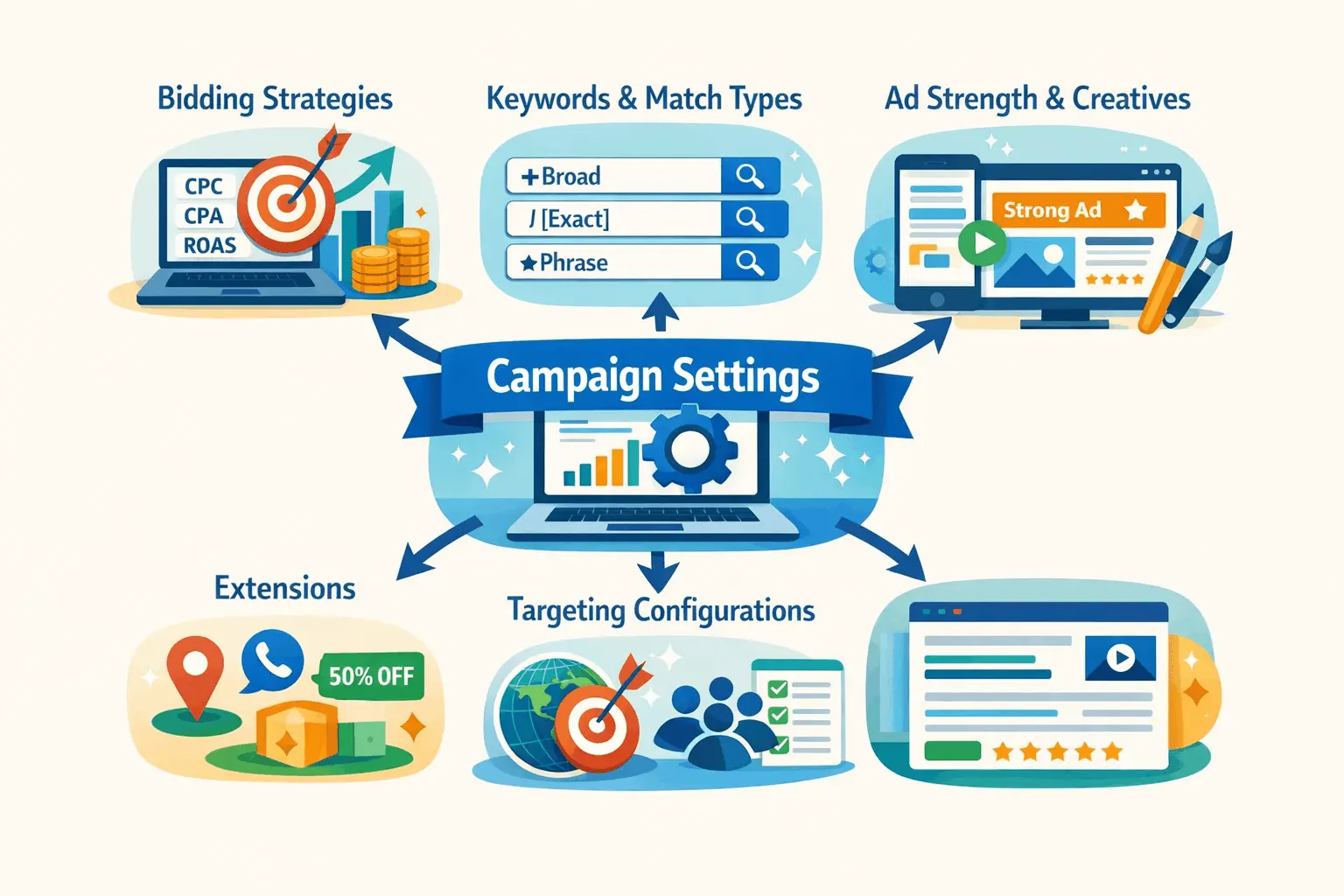
Google also offers customized recommendations in addition to the score, which are meant to enhance performance. The impact of every recommendation on your optimization score is also indicated.
The score, however, is not the final objective. Rather it is a directional guide which assists marketers to sense opportunities and move more swiftly.
We shall proceed to examine the two important ways it can assist marketers to succeed.
1. It Assists Marketers in Focusing on the High-Impact Improvements.
Knowing where to focus is one of the greatest campaign management threats. When dealing with several campaigns, ad groups and keyword groups, there is a tendency to become overwhelmed.
The Google Ads optimization score solves this by acting as a performance compass.
Obvious Diagnosis of Weaknesses.
When the optimization score of one campaign is 58% and the other one is 88% you immediately understand where you need your focus. However, the true worth is of deeper nature the platform justifies why the score is low.
It might suggest:
- Changing to a smarter approach to bidding.
- Including responsive search advertisements.
- Enhancing the types of keyword matches.
- Pausing redundant keywords
- Adding negative keywords
- Enhancing ad extensions
This does away with speculation in campaign audits. Marketers do not have to assess each setting individually but can focus on the area that needs improvement based on the recommendations provided by the analysis of the data.
Smarter Time Allocation
One of the scarce resources in marketing is time. The efficiency score assists in distributing effort effectively pointing out:
- High-opportunity campaigns
- Underperforming ad groups
- Missed automation features
- Budget allocation gaps
Marketers can work towards the areas that have the highest potential instead of allocating energy to all the campaigns the same way.
Strategic Alignment with Google Ads Quality Score Optimization
This is the point where optimization score is even stronger. When you align it with Google Ads quality score optimization, the impact multiplies.
Quality Score depends on:
- Click-through rate (CTR) will be expected.
- Ad relevance
- Landing page experience
These components are directly affected by a number of optimization score recommendations. For example:
- Responsive search ads enhance the strength of ads.
- Keywords should be refined to increase the relevance of ads.
- Enhancement of landing pages enhances user experience.
Marketers are likely to raise their optimization score as well as their Quality Score, which lowers cost-per-click and enhances the positioning of ads, when prioritizing these improvements in a strategic manner.
Business Impact
When prioritizing is done well, it will result in:
- Better budget utilization
- Higher conversion rates
- Reduced wasted spend
- Faster performance scaling
In brief, the first way optimization score is useful in making the marketers successful because it provides them with clarity. It converts disorder into order and plan.
2. It Makes Enhancements Implementation Faster
The second strong advantage is speed.
Optimization is time-consuming in many cases. Hours of manual labor may be required to test bids, targeting, experiment with ad copy, and improve keywords. The Google Ads optimization score simplifies this process dramatically.
Ready-to-Apply Recommendations
Marketers are provided with practical recommendations that can in many cases be implemented immediately as opposed to conducting a full audit.
Examples include:
- The ability to allow automated bidding plans.
- The inclusion of sitelinks or call extensions.
- Eliminating unnecessary keywords.
- Improving ad strength
- Increasing audience targeting.
Numerous suggestions can be done at the touch of a few clicks.
This will minimize the time between the problem and its resolution.
Faster Performance Gains
Paid advertising is time sensitive. The sooner you optimize the sooner you realize performance improvements.
When you respond swiftly on pertinent suggestions:
- CTR improves
- Conversion rates increase
- CPC may decrease
- Efficiency of the campaign is enhanced.
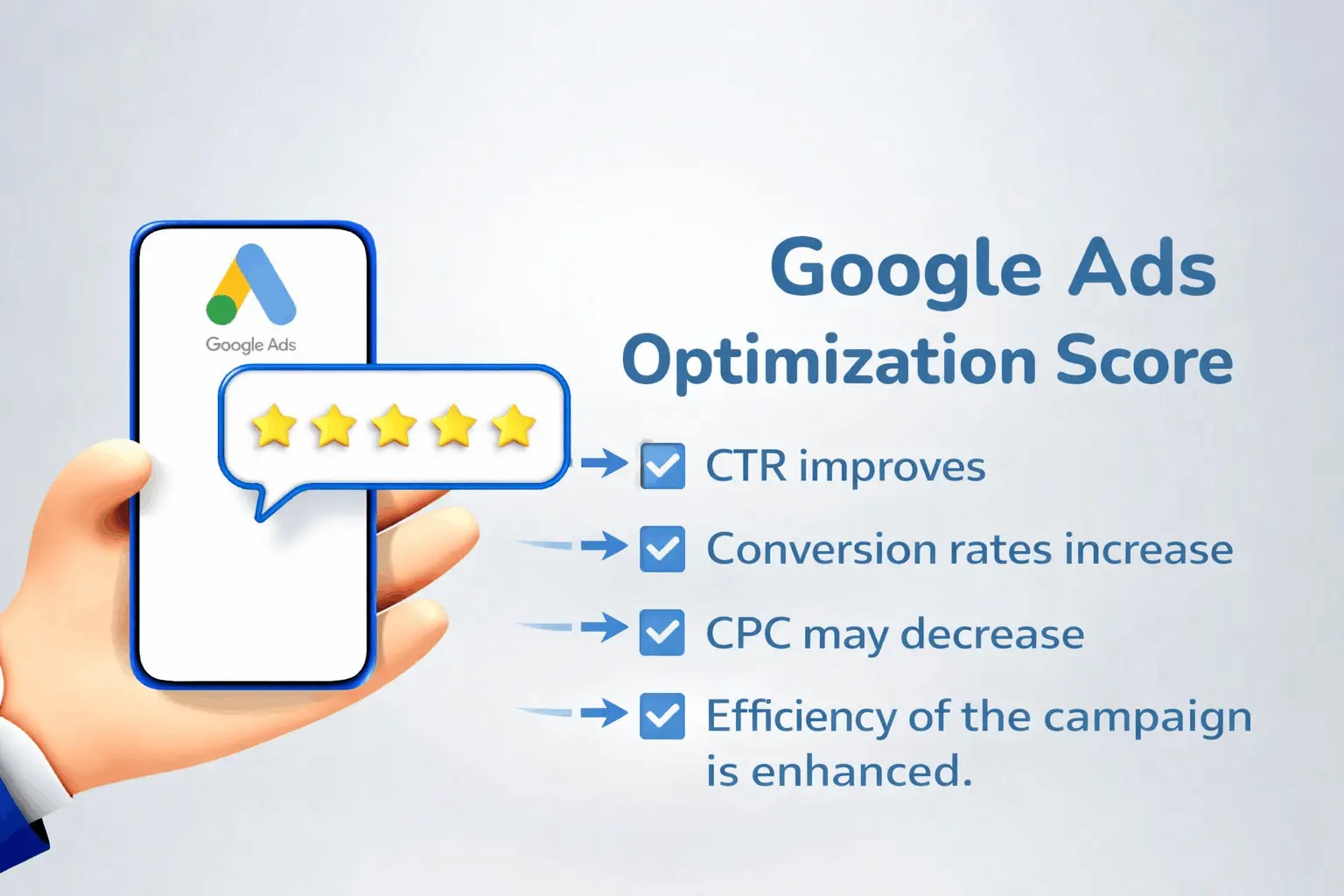
To take an example, cost-per-conversion can be boosted instantly with right campaign with smart bidding enabled provided that sufficient data is available. Irrelevant traffic can be filtered very easily by adding negative keywords.
Optimization score minimizes friction cycle in the improvement.
Enhancing Google Ads Quality Score Optimization
Quick implementation also benefits Google Ads quality score optimization efforts.
Suppose the system suggests:
- Improving ad strength
- Including more persuasive headlines.
- Refining keyword targeting
These changes are applicable in a way that they can have a beneficial effect on anticipated CTR and ad relevancy, which directly affect Quality Score.
The greater Quality Scores result in:
- Lower cost-per-click
- Better ad rank
- Higher impression share
So whereas optimization score helps in optimizing your campaign set-up, Quality Score improvements helps in optimizing your cost efficiency.
They combine to produce a compounding effect of performance.
Strategic Use: Blindly Not 100%.
While discussing what are two ways optimization score can help marketers succeed, it’s important to clarify one key point:
Be careful not to pursue a 100 percent optimization score.
All the suggestions do not match your business objectives. For example:
- Budget increase can lead to the improvement of the score but also spend beyond your limits.
- Widening of targeting can generate more traffic but low quality of leads.
- Automation might not be the right option where the data campaign is small.
Decisions should not be controlled by the optimization score, but guided.
The most intelligent marketers consider it a diagnostic tool rather than a guideline.
The significance of this to Long-term Marketing Success.
Winning in paid advertising does not mean only opening campaigns. It is about the constant improvement.
The Google Ads optimization score supports this by:
- Promoting continuous changes.
- Emphasizing the opportunities of automation.
- Determining structural weaknesses.
- Helping to support data-driven decisions.
When paired with strong Google Ads quality score optimization practices, it creates a system where:
- Ads become more relevant
- Costs become more efficient
- There is increased predictability in performance.
This eventually results in higher ROI and scalability.
Wrapping Up:
The Google Ads optimization score is a useful guide for improving campaign structure and performance, but it should align with conversions and ROI. Instead of chasing 100%, focus on strategic improvements. Indian SEO Agency PPC experts help optimize campaigns, improve Quality Score, and drive measurable, cost-effective advertising growth.
Visit our : Google Ads PPC Packages
FAQs:
Q. Is Google Ads optimization score important?
A. Yes, the Google Ads optimization score does have a bearing – however, not a performance assurance, but as a guide. It assists in the recognition of the opportunities to enhance campaign organization, bidding tactics, the strength of the ads, and targeting. Nevertheless, an increase in score does not necessarily imply an increase in conversions. It must be applied strategically together with such performance measures as CTR, conversion rate, CPA, and ROI.
Q. What is the best Google Ads optimization rating?
A. An optimal score of Google Ads would be around 80-100. But the optimum score will be based on what you want to achieve in your campaign. There are a lot of successful campaigns that perform with high scores of 75-85 percent when the recommendations do not correspond to their strategy. It is all about putting into practice appropriate recommendations not following 100 percent blindly.
Q. Should I work to achieve the goal of 100% Google Ads optimization score?
A. Not necessarily. As impressive as 100% may sound, not every business can be recommended to follow the recommendations. As an example, a recommendation to add budget or to add targeting can increase your score, but decrease profitability. Look at the recommendations that will help enhance performance measures as opposed to just raising the percentage.
Q. In how many instances does Google Ads optimization score refresh?
A. Google Ads optimization score is constantly updated with the changes in the campaign data. Your score can either soar or plummet when you implement suggestions or change the settings. It is suggested to check your score once a week to be active and find new optimization opportunities.
Q. Does Google Ads optimization score equal Quality Score?
A. No, they are not the same measures. The Google Ads optimization score is used to determine the effectiveness of your account setup in accordance with the recommendations of Google. Quality Score, in its turn, assesses the performance of keywords at the level of the expected CTR, ad relevance, and landing page experience. They are both significant, but they have varying purposes in campaign optimization.
Read More:
Branding in SERP Google for SEO Success and Authority Building
How often does Google Maps update?
How to Change YouTube Channel Name Without Losing Subscribers